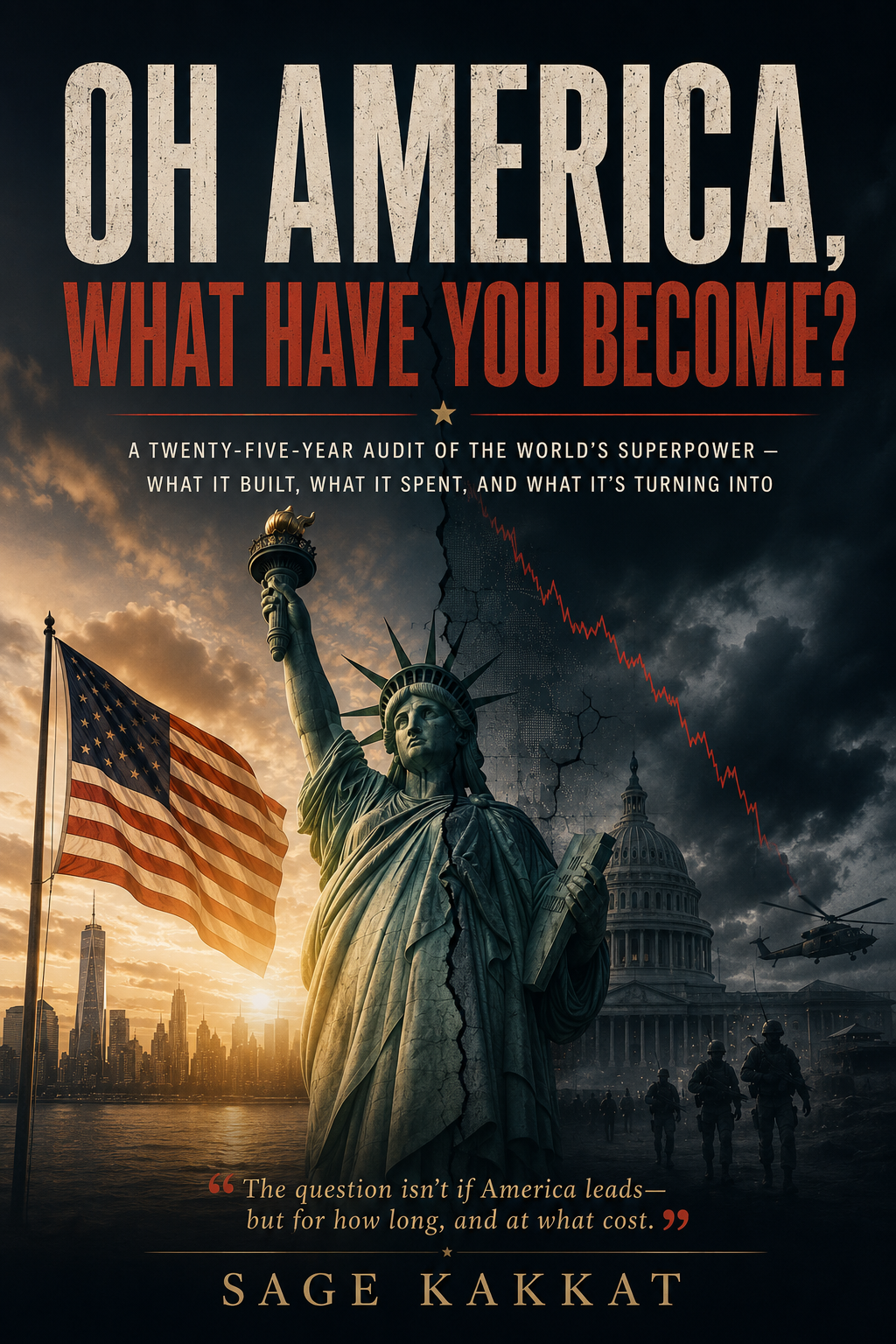
Oh America, what have you become?
What the world's superpower built, what it spent, and what it's turning into — currency, industry, debt, the Fed, technology, the military, alliances, and the institutions it wrote the rules for.
There is a version of America that still exists mostly in memory: the undisputed anchor of the global financial system, the workshop of the world, the guarantor of last resort for a security order it wrote the rules for. Twenty-five years on, almost none of that has disappeared — but almost none of it looks the same either. This isn't a story about collapse. It's a story about erosion at the edges, compounding faster than most people realize, of a set of exclusive privileges America used to hold outright and now merely holds the largest share of.
The last five years in particular — the pandemic and its aftermath — compressed a decade's worth of institutional stress-testing into a very short window: a Federal Reserve openly fighting for its independence against a sitting president, a tariff regime built and then struck down by the Supreme Court, and a return to unilateral military strikes across multiple continents after two administrations had promised to wind that era down. This piece walks through all of it — money, industry, debt, the Fed, technology, the military, alliances, domestic politics, demographics, culture, institutions, and public health — so the reader can draw their own conclusion about whether this is decline, adaptation, or some uncomfortable combination of both.
Still king, just not alone
Start with the most consequential number in the entire piece, because everything else is downstream of it: the dollar's share of global central bank reserves has fallen from roughly 71% in 2000 to around 56–57% as of late 2025, according to IMF COFER data. That's a decline of 14–15 percentage points over this piece's exact window — not a rounding error.
The mechanics matter, and they cut both ways. When the euro or yen appreciates against the dollar, dollar-denominated reserves shrink in relative terms even if no central bank sells a single Treasury. This is not a currency in freefall, and no single alternative — not the euro, not the yuan, not any basket — is remotely close to assuming the dollar's role.
But the reasons behind the diversification matter more than the number itself. The freezing of roughly $300 billion in Russian central bank reserves after 2022 demonstrated, to every finance ministry on earth, that dollar assets can be turned into leverage — instantly and irreversibly — against any country on the wrong side of Washington. That single episode did more to accelerate reserve diversification and gold accumulation among central banks in China, India, Russia, and the Gulf than a decade of "de-dollarization" commentary ever did. You cannot weaponize a currency and expect the rest of the world to keep treating it as neutral plumbing.
Bilateral trade increasingly settled outside the dollar — China-Russia energy, China-Brazil soy, India-UAE oil in rupees, Saudi openness to non-dollar oil sales for the first time since the 1970s petrodollar arrangement — none of it large enough yet to matter systemically. All of it large enough to matter as a signal.
Making things — and taxing them: the great tariff reversal
Manufacturing's share of US GDP has fallen from 15.1% in the early 2000s to roughly 9.4% today. Manufacturing employment as a share of total jobs has fallen from ~30% in the 1980s to roughly 8% now. The "China shock" that followed China's 2001 WTO accession did lasting, geographically concentrated damage that never fully reversed.
That backdrop is essential to understanding the legal and political drama of 2025–2026. In February 2025, the administration invoked the International Emergency Economic Powers Act (IEEPA) — a 1977 sanctions law never before used to impose tariffs — on Canada, Mexico, and China over fentanyl trafficking. In April 2025 it went further, declaring the trade deficit itself a national emergency and imposing "reciprocal" tariffs of 10–50% on virtually every trading partner on earth under the same statute — "Liberation Day." These IEEPA tariffs raised over $160 billion before being struck down — the largest tax increase as a share of GDP in more than three decades.
On February 20, 2026, the Supreme Court ruled 6–3 in Learning Resources v. Trump that IEEPA does not authorize tariffs at all — the statute never mentions tariffs, duties, or taxes. All IEEPA-based tariffs were terminated within days. The administration pivoted immediately to Section 122, 232, and 301 authorities. Refund litigation over the roughly $160–180 billion already collected remains unresolved.
For an investor audience, the substance of the dispute is arguably less important than what it reveals about the mechanism of policy: a signature economic policy was built, implemented, and generated real disruption to global supply chains for a full year — then invalidated by the judiciary as having exceeded presidential authority in the first place. That is a genuinely new kind of volatility to price in.
On the underlying manufacturing question, the read is unchanged by the legal drama: FDI into US manufacturing hit record levels in 2024 and construction spending roughly tripled between 2021–2025, but employment has been roughly flat to slightly down since the broadest tariffs took effect, and independent analysts have concluded it's too early to call this a genuine "reshoring boom." An estimated 400,000 manufacturing positions sit unfilled today, a number projected to rise toward 3.8 million by 2033 — a workforce gap that may prove the harder constraint than any tariff schedule.
The arithmetic of empire
This is the number that should worry any investor more than any single geopolitical headline: US federal debt held by the public crossed 100% of GDP in 2026, and total federal debt sits at roughly 122–125% of GDP — the highest sustained level in the nation's history outside the brief post-WWII spike. Total debt has surpassed $38–39 trillion.
Debt sustainability and currency credibility are the same conversation from two different angles. A country whose debt is projected to keep outgrowing its economy for the next thirty years, with no credible political consensus to address it, is a country whose creditors — foreign central banks and sovereign wealth funds — have every rational reason to hedge. This is the fiscal backdrop against which the dollar reserve diversification in Section I is happening. It's not a coincidence both trends accelerated over the same window.
Markets have, so far, shrugged — equity indices hit record highs around the same time debt crossed the symbolic 100%-of-GDP threshold. Some economists call that milestone "largely symbolic" and fully priced in. Others call it the calm of a frog that hasn't noticed the water temperature. Reasonable people disagree on which read is correct. What's not in dispute: the fiscal cushion that used to come free with reserve-currency status is measurably thinner than it was in 2000.
The Fed under siege
If one storyline best captures how much has changed in the machinery of American economic governance, it's the sustained, public, and unprecedented pressure campaign the executive branch waged against the Federal Reserve — an institution whose independence from short-term political control has, for half a century, been treated as a load-bearing wall of American economic credibility.
The pressure campaign escalated through 2025 into 2026. The president repeatedly called for immediate, large rate cuts — proposing what was termed "the Trump Rule" — and repeatedly threatened to remove Chair Jerome Powell, at one point posting that Powell's "termination cannot come fast enough." The Department of Justice opened a criminal probe into cost overruns on a Fed headquarters renovation, which Powell called a pretext for manufacturing "cause" for his removal, since chairs can only be dismissed for cause, not policy disagreement. In an action without precedent in the Fed's history, the administration attempted to fire Governor Lisa Cook over disputed mortgage fraud allegations — a court blocked it, and the matter reached the Supreme Court.
The Fed largely held the line. Powell insisted decisions would follow data — cooling employment, a historic government shutdown that left policymakers "flying blind" without official statistics for a stretch — rather than political demand. Internal dissent became unusually public, with governors breaking from consensus in both directions in a way not seen since the 1970s stagflation era.
If investors come to believe future Fed decisions will follow political direction rather than economic data, they demand higher yields to compensate, raising borrowing costs for the government, mortgages, and corporate credit simultaneously. Whether that repricing has already begun in a measurable way, or remains a tail risk still priced near zero, is genuinely contested among market economists as of mid-2026 — but the question being asked seriously at all, about the Federal Reserve of the United States, is itself a marker of how much has shifted.
The innovation frontier
If the industrial-era version of American prestige was steel mills and moon landings, the current-era version is frontier AI models, semiconductor design, and platform dominance — and this is genuinely the one area where American primacy hasn't just held over 25 years, it's arguably strengthened. The dominant AI labs, cloud infrastructure, chip design houses, and consumer platforms remain overwhelmingly American — soft power, hard power, and economic power fused into a single asset class with no obvious 20th-century analogue.
But the picture isn't uncomplicated. China has closed gaps faster than most analysts expected — in open-weight models, manufacturing-linked AI, and compute buildout tied to its domestic chip industry, an industry the US has tried to constrain at the fabrication level through semiconductor export controls. Those controls are themselves new economic statecraft: denying rivals the tools of innovation is a tacit admission that pure competitive advantage is no longer assumed sufficient on its own.
Big Tech has also become a geopolitical actor in a way that barely existed 25 years ago — with more real-time influence over information flow and commerce in dozens of countries than most mid-sized nation-states. European regulators, Indian data localization rules, and Chinese platform bans all represent power centers actively pushing back against unmediated American tech dominance.
The immigration and talent pipeline underneath all of this deserves its own mention: American AI dominance has historically been subsidized by importing the world's talent — a disproportionate share of frontier-lab founders and researchers were not born in the US. Any tightening of that pipeline is a direct threat to the one area where American exceptionalism is least contested.
The return of direct action: Iran, Venezuela, and the new interventionism
Until very recently, the military section of a piece like this would have been a straightforward story of retrenchment. That story is no longer complete on its own — the last eighteen months have produced one of the most active periods of direct US military intervention abroad in a generation, carried out by an administration that campaigned explicitly on ending foreign military entanglements.
In June 2025, after the IAEA assessed Iran was weeks from weapons-grade enrichment and Israel launched a broad strike campaign, the US struck three Iranian nuclear facilities including the fortified Fordow site. The administration called it a total success; early intelligence assessments reported by multiple outlets suggested the program was set back by months, not eliminated. Tensions reignited in early 2026 amid a domestic Iranian crackdown on protesters, and by late February a second, more expansive coordinated US-Israeli campaign explicitly aimed at regime change in Tehran followed the administration's declaration that negotiations had failed.
In parallel, strikes on alleged drug-trafficking vessels in the Caribbean escalated into a direct operation against Venezuela: on January 3, 2026, special operations forces raided a Caracas compound, captured President Nicolás Maduro and his wife, and flew them to the US to face trafficking charges. The administration framed follow-on justification partly around Venezuelan oil access. The operation drew condemnation from Russia, Iran, and a number of Democratic senators who argued it was unauthorized by Congress and violated international law — while several US-aligned regional governments received it with quiet approval even as it unsettled others about the precedent set.
Independent tracking found 658 air and drone strikes in the administration's first year back in office, spanning expanded operations in Iraq, Syria, Nigeria, and Somalia in addition to Iran and Venezuela, alongside floated action against Colombia and Cuba, talk of acquiring Greenland "by force," and domestic National Guard deployments in several US cities. Whether this reflects a coherent new doctrine of rapid, decisive force projection or a more improvised, transactional approach to individual crises is genuinely disputed among foreign policy analysts. What's not disputed: it has unsettled the assumption, held since at least the Afghanistan withdrawal, that America's appetite for unilateral military action abroad was in structural decline.
The shrinking shadow: primacy without predictability
The US still spends more on defense than the next six or seven countries combined, and still accounts for roughly a third of all global military expenditure — that hasn't meaningfully changed in 25 years. What's changed is the share of GDP that spending represents, and, per Section VI, the manner in which that capability is now being used.
Defense spending sat at 3–3.4% of GDP through most of the 2020s, down from ~4.5% during the Iraq/Afghanistan buildup, and radically down from Cold War and Vietnam-era levels. That's less decline than a natural consequence of the economy outgrowing the military budget — but it coincides with a real shift in posture, from an assumed global-policeman role operating through alliance structures and congressional authorization, to a far more selective, transactional, and — per Section VI — unilateral approach to the actual application of force.
The knock-on effect has been a genuine redistribution of the global security burden. NATO allies committed at the 2025 Hague summit to raising combined defense and security spending to 5% of GDP by 2035 — a dramatic jump from the long-unmet 2% target. European "strategic autonomy" rhetoric has moved from a French talking point to a mainstream EU conversation, sharpened rather than eased by the unpredictability discussed above. Russia has pushed military spending to an estimated 6% of GDP amid the Ukraine war; China's opaque but rising budget continues a modernization push aimed at complicating American power projection in the Pacific. The nuclear modernization race many assumed had ended with the Cold War has quietly restarted, with the US Triad replacement alone estimated at over $750 billion over the next decade.
Alliances in a multipolar world
The cleanest way to describe the last 25 years geopolitically is the transition from a unipolar moment to an acknowledged multipolar order — acknowledged not because America stopped being the single largest power, but because enough other actors became large or independent enough that "unipolar" stopped accurately describing how decisions get made.
India has spent this quarter-century refusing full alignment with either Washington or Beijing, buying Russian oil and weapons while deepening ties with the US on trade and technology. The Gulf states pursue the same hedging logic: American guarantees remain valuable, but so does Chinese infrastructure investment, and increasingly, so does non-alignment as leverage in itself. Turkey, a NATO member, has played a genuinely independent game between Russia, the EU, and the US. An expanded BRICS bloc and a more coordinated Global South voice represent, loosely, a growing bloc less willing to simply take Washington's cue by default.
None of this means these countries are anti-American — most of it is rational diversification, reinforced more recently by the unilateral strikes in Section VI, which several regional partners have quietly welcomed against shared adversaries even as they privately worry about being on the receiving end of similar action themselves someday. The practical effect: American diplomatic requests now compete for buy-in rather than commanding automatic deference.
Domestic politics as a foreign policy variable
Twenty-five years ago, foreign governments and capital could reasonably assume continuity in American policy regardless of party — shifts at the margins, not the foundations. That assumption has weakened considerably. A signature trade policy struck down by the Supreme Court within a year, and a sustained public campaign to bend the central bank toward short-term political preference, are the clearest recent illustrations. Entering and exiting the same international agreements more than once within a single generation has made American policy predictability itself a variable that investors now have to price in, the way they'd price currency or regulatory risk anywhere else.
This is a genuinely new category of "country risk" applied to the country that used to be everyone's safe haven. It doesn't mean capital is fleeing — American markets remain the deepest and most liquid in the world. But sovereign wealth funds and multinational corporations now openly discuss "US political risk" in the same conversations where they'd once discussed emerging-market risk — a strange sentence to say out loud in 2000.
Domestically, wealth concentration has grown substantially since 2000, reshaping both the lived experience of the "American Dream" and how that dream is perceived from abroad. A country whose median worker feels increasingly locked out of the prosperity its aggregate statistics still boast about is a harder country to hold up as an aspirational model.
Who gets to be American
One of America's most durable advantages has been its capacity to absorb, and be renewed by, immigration — offsetting the aging and birth-rate decline affecting nearly every advanced economy, and importing disproportionate shares of global entrepreneurial and technical talent. That advantage has become one of the most politically contested fault lines of the last 25 years, with policy swinging sharply between administrations in ways that create real uncertainty for the talent pipeline the tech and research sectors depend on.
The demographic math underneath this is arithmetic, not ideology. Birth rates have declined, the population is aging, and the ratio of working-age taxpayers to retirees drawing Social Security and Medicare is worsening — feeding directly back into the fiscal trajectory in Section III. Immigration is mechanically one of the few available levers to soften that trajectory; a political environment more skeptical of immigration than at any point in decades pulls in the opposite direction from what the math would suggest is prudent.
Culture wars and culture exports
American cultural exports — Hollywood, streaming, pop music, gaming — remain globally dominant in raw reach, and that hasn't meaningfully eroded the way harder economic metrics have. But the competitive landscape has genuinely diversified: K-pop and Korean drama built a global youth-culture footprint essentially from scratch over this exact period; Bollywood's international reach has grown; Chinese platforms — TikTok most visibly — became, for a period, the dominant cultural product among a huge share of the world's teenagers, built entirely outside the American cultural-industrial complex.
Domestically, the last 25 years have been marked by open, sustained argument over what American identity and values actually mean — argument sharp enough, and public enough, that it's visible from abroad in a way that complicates the country's traditional role as a stable cultural and moral exemplar.
Institutions and the rules America wrote
The postwar order — the UN, IMF, World Bank, GATT/WTO — was substantially an American creation, built to entrench American-favorable rules while offering enough genuine multilateral benefit that the rest of the world bought in. Over the last 25 years the US has increasingly behaved as a more selective, sometimes reluctant participant in that same order — withdrawing from or threatening various UN bodies, treating WTO dispute mechanisms as optional when inconvenient, using unilateral tariff authority that sidestepped the very rules Washington once insisted others follow (at least until the Supreme Court intervened) — and, per Section VI, conducting military operations that international law scholars and foreign governments have characterized as UN Charter violations.
This selective application is a credibility problem, not just a policy one. Every country watching the US invoke international law when convenient and set it aside when not draws the obvious conclusion — and reasonably asks why it should keep deferring to rules written by a hegemon that no longer consistently follows them. China's alternative institution-building — the AIIB, an expanded New Development Bank, Belt and Road financing — is a direct response to exactly that opening.
Public health and the body of the nation
This is the least "financial" section of this piece, but it belongs here because national resilience and credibility are ultimately downstream of whether a country's own population is thriving. US life expectancy gains have flattened and, in some years, reversed relative to peer OECD nations — an unusual divergence for a country at America's income level, driven by the opioid crisis, rising chronic disease, and uneven healthcare access. The COVID-19 response became, for a period, a live global comparison point on state capacity, and the US did not emerge looking like the gold standard it had implicitly claimed to be for most of the 20th century.
None of this is a uniquely American failure — these pressures hit every advanced economy. But the gap between America's continued self-image as the world's leading nation and its middling-to-poor performance on basic public health outcomes relative to peers is one of the more concrete ways the "what have you become" question shows up in hard data rather than rhetoric.
What persists
Add all of this up and the honest answer is neither "America is dead" nor "nothing has changed." America has gone from holding a set of exclusive privileges — the only real reserve currency, the only real superpower, the undisputed technological leader, an independent central bank nobody seriously questioned, a foreign policy predictable enough that allies and rivals alike could plan years ahead — to holding the largest share of a more contested and considerably less predictable version of the same privileges.
The dollar is still dominant, but no longer unquestioned. The military is still the largest by far, but allies now plan around its reliability as conditional, and rivals now plan around unilateral strikes with little warning. The tech sector is still the world leader, but the gap is closing and the talent pipeline is under domestic pressure. The institutions America built still exist, but America's commitment to them — and its own central bank's independence from it — is now treated as negotiable rather than foundational. The debt load is still serviceable, but the margin for error is thinner than it was in 2000, and a signature economic policy was built and dismantled by the Supreme Court within a single year.
Britain's shift from unquestioned 19th-century hegemon to a still-influential but no-longer-singular power took decades and never fully "ended" so much as settled into a smaller-but-durable equilibrium. Whether America is early in that same multi-decade settling process, or still has genuine capacity to reassert something closer to its old exclusivity — particularly through the AI and technology lead that remains its clearest unambiguous advantage — is the actual open question. Anyone telling you they know the answer with certainty, in either direction, is selling something.
What can be said with more confidence: the America an investor, an ally, or a rival is dealing with in 2026 is not the America of 2001, and arguably not even the America of 2020, on almost any axis that matters. Something did die over the last 25 years, and the last two in particular: the assumption of automatic, unquestioned primacy, and the assumption of institutional continuity that made American policy predictable regardless of who held office. What's replaced it — a still-formidable, still-central, but genuinely contested and considerably less predictable America, operating in a world it no longer designs unilaterally — is the version long live has to mean, if the phrase is going to mean anything honest at all.
