
- Investors are pulling back from high-flying technology stocks as concerns over stretched valuations ripple across global markets. South Korea's Kospi Index has now fallen 10% from its record high, while Nasdaq 100 futures dropped 2.6% and S&P 500 futures slid 1.4%. The pressure followed a selloff in major US technology shares, with investors questioning whether hyperscalers such as Alphabet can justify their massive AI spending. A less accommodative Federal Reserve backdrop could also be adding pressure to risk appetite.
- In Seoul, SK Hynix (HXSCL) and Samsung Electronics (SSNLF) both dropped more than 10%, while Intel (NASDAQ:INTC) and Micron Technology (NASDAQ:MU) led losses among US chipmakers in premarket trading. Memory stocks, many of which have posted triple-digit gains this year, were among the steepest decliners as investors appeared to take profits after a strong run. Investors are now turning their attention to Micron's quarterly results on Wednesday, with the stock having rallied more than 300% since January, making it this year's standout performer in the Philadelphia Semiconductor Index.
- The risk-off mood is also spreading into other parts of the market. SpaceX (NASDAQ:SPCX) fell 4.5% and was poised to trade below its first-day opening price of $150, while Chinese equities in Hong Kong entered a bear market. State Street Markets' Marija Veitmane noted that institutions had increased holdings in tech since the start of the Iran war, making some volatility and profit-taking less surprising. Brent crude fell for a second straight day, down 0.7% to $77.40 a barrel, as traders took comfort from early signs of progress in US-Iran talks and a 60-day license allowing Tehran to sell oil internationally. National Australia Bank strategist Rodrigo Catril said markets appeared more worried about US tech weakness than encouraged by lower oil prices, adding that risk aversion was in the air.
- Regional markets took a weak lead-in from Wall Street, where tech stocks also fell during the overnight session. The sector was hit by heavy profit-taking as investors sold on fears of higher U.S. interest rates this year, with heavyweights including Alphabet and SpaceX logging deep losses.
- Iranian and U.S. officials appeared to make progress in talks held in Switzerland over the weekend, helping ease immediate concerns over a disruption to oil supplies through the Strait of Hormuz.
- But investors remained cautious amid uncertainty over the durability of any agreement. Markets were also digesting last week’s hawkish Federal Reserve meeting, which prompted traders to further scale back expectations for U.S. interest rate cuts.
- South Korea’s KOSPI was the region’s worst-performing major benchmark, falling nearly 10% after recently scaling record highs.
- Tuesday’s decline in SK Hynix was exacerbated by reports that the company was scaling back the pace of its HBM4 expansion and shifting resources toward conventional DRAM production, where margins have recently overtaken those of HBM.
- The development fuelled speculation that Samsung Electronics could narrow the gap in supplying HBM for advanced memory chips.
- The latest selloff reflects a sharp unwinding of crowded AI and semiconductor trades that have dominated Asian equity performance for much of 2026. South Korean shares have been among the biggest beneficiaries of the global AI boom, with foreign investors pouring into memory-chip makers amid surging demand for advanced semiconductors used in AI servers and data centres.
- Index heavyweight and major AI beneficiary Hyundai Motor (KS:005380) also slid over 12%.
- Japan’s Nikkei 225 slid 3.5%, while the TOPIX tumbled 2.6%, with chip-related and export-oriented stocks giving back some of their recent gains after both indexes touched record highs earlier this week.
- Japanese purchasing managers index data showed both manufacturing and services activity picked up in June, although it also showed a sharp increase in input prices due to disruptions caused by the Iran conflict.
- A sustained increase in producer prices is expected to invite more hawkish moves from the Bank of Japan, after it raised interest rates last week.
- Chinese markets also logged deep losses. The Shanghai Shenzhen CSI 300 slid 2.8%, while the Shanghai Composite fell 1.4% on continued losses in tech.
- Hong Kong’s Hang Seng index slipped 1.8%, also pressured by weakness in heavyweight technology and electric vehicle stocks.
- Australia’s ASX 200 fell 0.3% ahead of key inflation and labor market data due later this week. The releases are expected to provide fresh clues on the Reserve Bank of Australia’s policy outlook, after the central bank announced a pause in its rate hike cycle.
- The ASX also benefited from having relatively less tech weightage than most of its Asian peers.
- India bucked the regional weakness slightly, with the Nifty 50 falling 0.6%, relatively less than some of its regional peers.
Global Indices:
Global Indices Dashboard
S&P 500 - United States Dow Jones - United States Nasdaq 100 - United States DAX - Germany CAC 40 - France FTSE 100 - United Kingdom Nikkei 225 - Japan EWH - Hong Kong Sensex - India ASX 200 - Australia MOEX - Russia MERVAL - Argentina Bovespa
 Sage Kakkat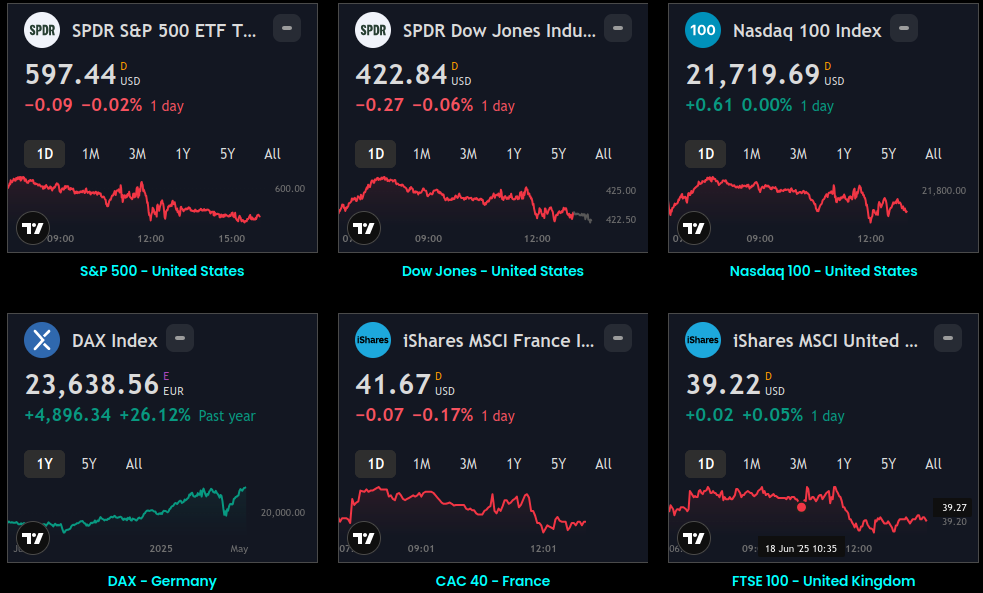
Active Stocks:
Active Stocks
See the top five gaining, losing, and most active stocks for the day. It updates based on current market activity – so you’ll always see the most relevant stocks Track all markets on TradingView
 Sage Kakkat
Stocks, ETFs and Funds Screener:
Stocks, ETFs and Funds
Separate the wheat from the chaff – handy for sorting symbols both by fundamental and technical indicators. Sort Assets and Filter by Region, Type, Sector, Industry and Country
 Sage Kakkat
Forex:
Foreign Exchange Dashboard
Heatmap and Real-time quotes of selected currencies in comparison to other major currencies. Sort currencies both by fundamental and technical indicators
 Sage Kakkat
CryptoCurrency:
Crypto Currency Dashboard
CRYPTO HEATMAP OVERVIEW Assets by Market Capitalization
 Sage Kakkat
Events and Earnings Calendar:
Events & Earnings
Keep an eye on key upcoming economic events, announcements, and news. Track all markets on TradingView
 Sage Kakkat
This daily briefing is curated from a wide range of reputable sources including news wires, research desks, and financial data providers. The insights presented here are a synthesis of key developments across global markets, intended to inform and spark thought.
6No Investment Advice: This content is for informational purposes only and does not constitute investment advice, recommendation, or endorsement.
Timing Note: Each edition is assembled based on the market context available at the time of writing. Timing, emphasis, and interpretations may vary depending on global developments and publishing windows.
