
- US stock futures steadied on Wednesday after a second bruising day for techs, with Wall Street looking to Micron's (MU) earnings later for a health check on AI demand.
- Worries about lofty valuations and massive spending, alongside fears of coming interest-rate hikes, have prompted a wave of profit-taking in high-flying AI-linked stocks.
- Micron's earnings are due after the bell on Wednesday, and the results will be closely watched as Wall Street assesses just how much faith to put in AI. Its shares have been on a tear this year, rising more than 250%, but they sank 13% on Tuesday amid the tech rout.
- Late Tuesday, Cerebras (CBRS) posted its first earnings report since going public in May. Shares of the AI chipmaker dropped over 10% in premarket after it forecast profit margins would lag those from rivals such as Nvidia (NVDA).
- Meanwhile, uncertainty persists over US-Iran talks and where key issues might ultimately land. While President Trump had pledged the Strait of Hormuz would remain free of tolls, Iran and Oman have started discussing a system to charge fees for ships to cross the key supply-flow waterway.
- FedEx (FDX) cited rising transportation costs and the impacts of shifting trade policy for shrinking operating margins in its after-hours earnings report. Shares in the delivery company, seen as a bellwether for the broader economy, slid before the bell.
- Asian stocks traded mixed on Wednesday, with South Korean shares leading a regional rebound as easing tensions in the Middle East improved risk appetite, while investors remained wary of stretched technology valuations following a sharp global selloff in AI-linked stocks.
- Investor sentiment improved after signs emerged that tanker traffic through the Strait of Hormuz was gradually normalizing following a reduction in hostilities between Iran and Israel. Reports that more vessels stranded in the Gulf since the outbreak of the conflict were preparing to transit the strategic waterway eased concerns over disruptions to global crude supplies and helped keep oil prices near recent lows.
- Regional markets took a mixed lead from Wall Street after a rout in technology shares erased roughly $1.3 trillion in market value and rattled confidence in the AI trade. While U.S. stock futures pointed to a modest recovery, investors remained cautious ahead of earnings from memory-chip maker Micron Technology and upcoming U.S. inflation data, both of which are expected to provide fresh clues on AI spending and the Federal Reserve’s policy outlook.
- South Korea’s KOSPI surged 3.3%, recovering part of Tuesday’s nearly 10% slump, its steepest one-day decline since March. Technology and semiconductor stocks led gains as investors returned to beaten-down names after the previous session’s AI-driven rout.
- Japan’s Nikkei 225 fell 0.8%, while the broader TOPIX lost 0.7%, making Japan one of the few major regional laggards. Sentiment was pressured by a summary of opinions from the Bank of Japan (TYO:8301)’s June meeting, which showed several policymakers favoring further interest-rate increases after last week’s move to raise rates to 1.0%. The comments reinforced expectations that the BOJ will continue gradually normalizing policy, raising concerns over borrowing costs and corporate earnings.
- Australia’s S&P/ASX 200 gained 0.2% after inflation data painted a mixed picture. Headline inflation eased in May, but underlying price pressures accelerated and remained above the Reserve Bank of Australia’s target range, reinforcing expectations that policymakers will maintain a hawkish stance despite signaling a pause earlier this month.
- Chinese markets edged higher, with the Shanghai Shenzhen CSI 300 rising 0.5%, the Shanghai Composite adding 0.1%, and Hong Kong’s Hang Seng gaining 0.4%, aided by improving risk sentiment and expectations of further policy support.
- Indonesia’s Jakarta Stock Exchange Composite Index fell 2.4%, making it the region’s worst performer after MSCI extended its review of the country’s equity market and warned it could consider reclassifying Indonesia to frontier-market status if reforms aimed at improving market accessibility and transparency fail to show sufficient progress.
- The move revived concerns over foreign outflows and investor confidence in Southeast Asia’s largest economy, whose benchmark stock index has already suffered steep losses this year amid concerns over governance, market liquidity and policy direction.
- Elsewhere, Thailand’s SET Index rose 0.6% after the Bank of Thailand left interest rates unchanged as widely expected. Policymakers maintained a cautious stance on inflation, reinforcing expectations that rates could remain on hold despite lingering growth concerns.
- India outperformed, with the Nifty 50 rising 0.7% and the BSE Sensex 30 gaining 0.8%, while Singapore’s FTSE Straits Times Singapore added 0.2% and Malaysia’s FTSE Malaysia KLCI rose 0.5%. The Philippines’ PSEi Composite fell 2.2%, making it one of the region’s weakest performers as investors booked profits after recent gains and turned cautious ahead of domestic economic data and interest-rate signals.
- Investors are now looking toward Micron’s earnings, Friday’s U.S. PCE inflation report and further developments in the Middle East for direction.
Global Indices:
Global Indices Dashboard
S&P 500 - United States Dow Jones - United States Nasdaq 100 - United States DAX - Germany CAC 40 - France FTSE 100 - United Kingdom Nikkei 225 - Japan EWH - Hong Kong Sensex - India ASX 200 - Australia MOEX - Russia MERVAL - Argentina Bovespa
 Sage Kakkat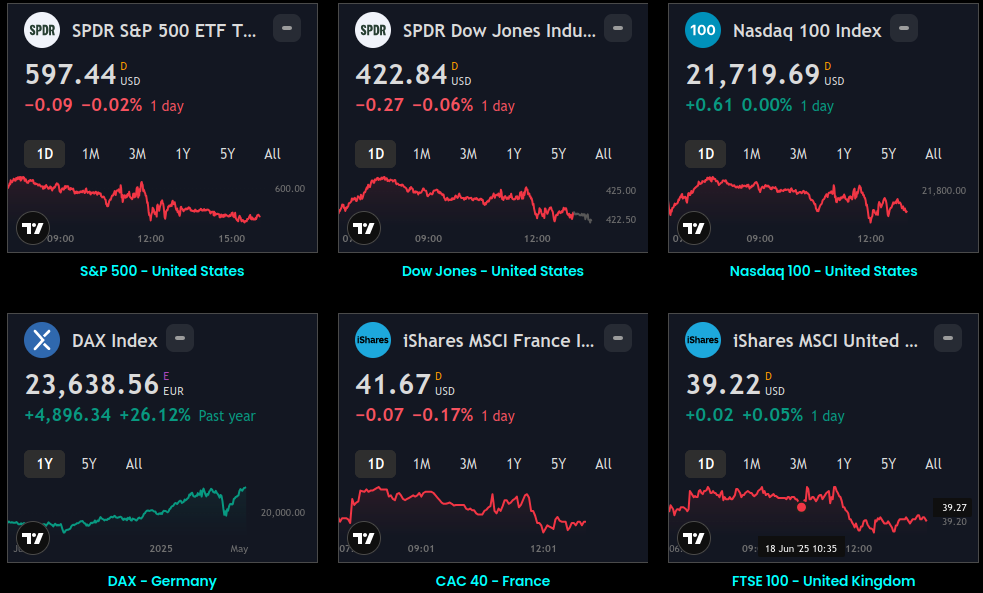
Active Stocks:
Active Stocks
See the top five gaining, losing, and most active stocks for the day. It updates based on current market activity – so you’ll always see the most relevant stocks Track all markets on TradingView
 Sage Kakkat
Stocks, ETFs and Funds Screener:
Stocks, ETFs and Funds
Separate the wheat from the chaff – handy for sorting symbols both by fundamental and technical indicators. Sort Assets and Filter by Region, Type, Sector, Industry and Country
 Sage Kakkat
Forex:
Foreign Exchange Dashboard
Heatmap and Real-time quotes of selected currencies in comparison to other major currencies. Sort currencies both by fundamental and technical indicators
 Sage Kakkat
CryptoCurrency:
Crypto Currency Dashboard
CRYPTO HEATMAP OVERVIEW Assets by Market Capitalization
 Sage Kakkat
Events and Earnings Calendar:
Events & Earnings
Keep an eye on key upcoming economic events, announcements, and news. Track all markets on TradingView
 Sage Kakkat
This daily briefing is curated from a wide range of reputable sources including news wires, research desks, and financial data providers. The insights presented here are a synthesis of key developments across global markets, intended to inform and spark thought.
6No Investment Advice: This content is for informational purposes only and does not constitute investment advice, recommendation, or endorsement.
Timing Note: Each edition is assembled based on the market context available at the time of writing. Timing, emphasis, and interpretations may vary depending on global developments and publishing windows.
