
US Stocks head into the weekend under heavy selling pressure as a three-headed monster of deepening chip losses, a Netflix miss, and Trump's allegation that China stole 220 million voter files rattles risk sentiment across every asset class heading into Friday's close.
- Nasdaq-100 futures fell as much as 2% and S&P 500 futures dropped nearly 1% in premarket, with Dow Jones futures down 350 points or 0.6%, as semiconductor stocks extended losses for a third straight session. The Philadelphia Semiconductor Index (SOX) is on track for its worst weekly decline since March 2025 and is now down nearly 20% from recent highs — approaching correction territory for the sector. The iShares Semiconductor ETF fell 2.4% in premarket.
- Netflix (NFLX) tumbled 10–11% in premarket after reporting Q2 EPS of $0.80 — narrowly beating the $0.79 estimate — on revenue of $12.56 billion, marginally missing the $12.587 billion consensus. The bigger blow was Q3 guidance: the company projected Q3 revenue of $12.86 billion versus the $13.006 billion FactSet estimate and EPS of $0.82 against the $0.84 consensus. Netflix narrowed its full-year revenue view to $51.0–$51.4 billion, below analyst expectations. AJ Bell investment director Russ Mould noted that "Netflix disappointments are on their way to becoming a regular series rather than a one-off event."
- Chip stocks were broadly lower in premarket, extending Thursday's brutal session. Nvidia (NVDA) and Intel (INTC) each fell 2.7–2.8%, while SanDisk (SNDK), Western Digital (WDC), Seagate (STX), and Micron Technology (MU) dropped between 4.6% and 6.5%. Arm Holdings (ARM) fell sharply after losing more than 5% Thursday. Alphabet (GOOGL) dropped 4% Thursday after a report it is delaying the release of its next major AI model, adding to the AI-valuation reset that has gripped the market all week.
- Trump escalated tensions with China late Thursday, revealing declassified intelligence alleging China illicitly acquired voter registration data for 220 million Americans — calling it the largest election-data breach in history in a primetime address. Markets reacted with the Australian dollar weakening as a G10 proxy for China sentiment, while the PBOC set its USD/CNY reference rate at 6.7934, above the 6.7734 estimate, suggesting modest capital pressure. The allegations risk unsettling the US-China trade truce that has held since last year's tariff negotiations, with Trump and Xi Jinping scheduled to meet in coming weeks.
- Iran said Friday it launched fresh strikes on US facilities across the Gulf — the seventh consecutive night of exchanges — including what Iranian state media described as the first direct attack on US targets in Syria, alongside new strikes in Jordan, Bahrain, and Kuwait. Reports emerged that Iran targeted the King Fahd Causeway connecting Bahrain to Saudi Arabia. The widening geographic scope of the conflict, now touching five nations, pushed oil higher. WTI crude held near $79 per barrel and Brent rose, with oil set for its biggest weekly gain since April. Fed Vice Chair Philip Jefferson said the Fed is "well positioned" on rates but opened the door to a later-year hike without endorsing an immediate move, with current inflation data declining.
- Bitcoin (BTC) fell below $63,000 in Asian trading, extending Thursday's 1.4% slide from $65,000, as the dual weight of Iran escalation and Trump's China allegations hit risk assets. Gold futures were rising in early trade. The 10-year Treasury yield moved higher as oil prices kept inflation concerns alive despite the softer CPI earlier in the week. Michigan Consumer Sentiment for July is due at 10:00 a.m. ET this morning.
- Japan's Nikkei 225 plunged 4.25–6.1% Friday — sources varied on the closing level but it was the index's worst session in weeks — putting the Nikkei at its lowest in over a month and extending a brutal week for Japanese tech and memory-related stocks. Kioxia, SoftBank, Tokyo Electron, and Advantest all fell sharply. Taiwan's TAIEX closed 5.9% lower as semiconductor names led broad declines, with investors in Taipei bracing for further US chip export restriction headlines. South Korea's KOSPI was closed for a public holiday — Constitution Day — after suffering steep losses of 6.4–7.6% in Thursday's session. Singapore's Straits Times Index fell 0.5% as June non-oil domestic exports grew less than expected following several months of strong performance. Australia's S&P/ASX 200 slipped 0.5%. India's Nifty 50 rose 0.6% in early trade, a rare pocket of regional resilience. MSCI's Asia-Pacific index ex-Japan fell broadly as the global tech selloff accelerated heading into the US open.
Global Indices:
 Sage Kakkat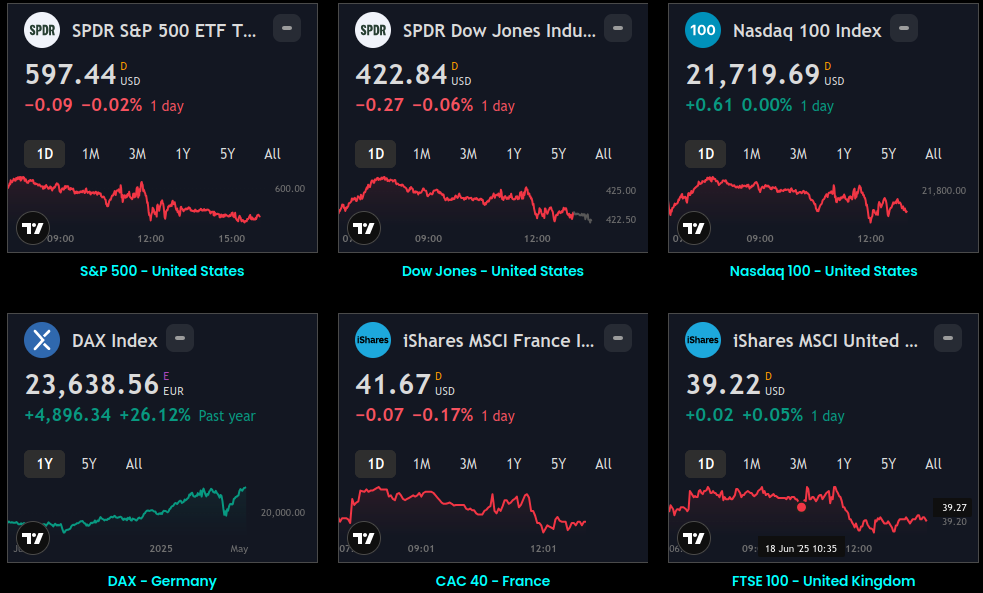
Active Stocks:
 Sage Kakkat
Stocks, ETFs and Funds Screener:
 Sage Kakkat
Forex:
 Sage Kakkat
CryptoCurrency:
 Sage Kakkat
Events and Earnings Calendar:
 Sage Kakkat
This daily briefing is curated from a wide range of reputable sources including news wires, research desks, and financial data providers. The insights presented here are a synthesis of key developments across global markets, intended to inform and spark thought.
No Investment Advice: This content is for informational purposes only and does not constitute investment advice, recommendation, or endorsement.
Timing Note: Each edition is assembled based on the market context available at the time of writing. Timing, emphasis, and interpretations may vary depending on global developments and publishing windows.