
US Stocks open mixed as a "sell the news" reaction to TSMC's blowout earnings triggers a third straight session of chip sector losses, with the AI trade under the most sustained pressure of the year even as UnitedHealth and bank stocks drive a broadening rotation, Netflix earnings land after the close, and Starship's next test flight is set for tonight.
- Dow Jones futures rose 0.3% or about 145 points in premarket, supported by UnitedHealth's strong Q2 beat, while S&P 500 futures slipped 0.28% and Nasdaq-100 futures fell 0.91% as chip stocks extended Wednesday's losses. The broader market closed Wednesday with the S&P 500 up 0.38%, Nasdaq up 0.9%, and the Dow adding 9.63 points, but momentum reversed sharply overnight on TSMC's capex shock.
- TSMC (TSM) reported Q2 net profit surging 77.4% year-over-year to NT$706.56 billion — a record — with revenue climbing 36% to NT$1.27 trillion, beating the NT$1.264 trillion LSEG SmartEstimate. Despite the blockbuster result, US-listed shares fell 3.2–5% in premarket as investors reacted negatively to TSMC's decision to raise full-year capital expenditure guidance to $60–$64 billion from the prior high-end range of $52–$56 billion. The company also announced an additional $100 billion investment in the United States. The raised capex guidance stoked fears that AI infrastructure spending has overshot near-term demand, triggering a sell-the-news rotation out of the entire semiconductor complex.
- UnitedHealth Group (UNH) surged more than 7% in premarket after posting better-than-expected Q2 results and raising its full-year earnings outlook, making it the standout premarket gainer and the primary driver of Dow futures strength. GE Aerospace (GE) fell 4% despite beating Q2 estimates — reporting adjusted EPS of $2.02 on revenue of $12.63 billion against expectations of $1.86 EPS on $11.86 billion — and raising full-year guidance, as investors read the results as already priced in. United Airlines (UAL) fell more than 2% despite topping earnings estimates after issuing softer-than-expected Q3 guidance of $2.50–$3.50 per share versus FactSet estimates of $3.53, with management citing $6 billion in added fuel costs from the Iran war.
- Netflix (NFLX) reports after the close today in one of the most closely watched results of the earnings season, with analysts scrutinizing ad-supported tier revenue performance and content amortization trends. J.B. Hunt Transport Services (JBHT) jumped nearly 7% in premarket after reporting EPS of $1.73, beating estimates by 18 cents, with management citing increased intermodal demand throughout the quarter as a positive read on freight and logistics trends.
- The VanEck Semiconductor ETF (SMH) declined about 2.2% in premarket, led by a roughly 4% drop in Arm Holdings (ARM). Micron Technology (MU) tumbled more than 8% in Wednesday's session. SanDisk (SNDK) and Western Digital (WDC) were among the early premarket losers. SK Hynix US-listed shares (SKHY) fell sharply. The Philadelphia Semiconductor Index (SOX) fell 2.07% Wednesday. The chip selloff is being framed by analysts as simultaneous profit-taking and valuation fatigue after an extraordinary run rather than a fundamental demand deterioration — HSBC noted the market is "underestimating the potential for a big US earnings beat in Q2" across the broader economy.
- The US has now launched strikes on Iran for a sixth consecutive day, keeping oil elevated. Brent crude rose 1.1% to near $85.50 per barrel on Thursday, its fourth straight day of gains, even as WTI crude retreated modestly. Trump said Wednesday that Iran had expressed a willingness to negotiate, though Tehran continued to project readiness for further conflict and defense analysts told CNBC there was little indication an Iran diplomatic resolution was close. June retail sales data and weekly jobless claims are due at 8:30 a.m. ET.
- SpaceX (SPCX) gained 1.3% to $137.81 ahead of Starship's next critical test flight, scheduled for no earlier than 6:45 p.m. ET Thursday from Starbase, Texas. ASML (ASML) rose 3.4–3.6% Wednesday after its guidance raise but reports surfaced that the Dutch chipmaker plans to raise prices on its lithography equipment — a development that added to chip sector cost pressure overnight.
- South Korea's KOSPI plunged 6.4–7.6% intraday Thursday — entering a formal bear market after the Bank of Korea raised interest rates for the first time since January 2023 — closing down 6.4% as SK Hynix and Samsung Electronics led losses. The Kosdaq fell 1.97%. Regulators reversed course on single-stock leveraged ETFs tied to Samsung and SK Hynix — approved just two months ago in May — announcing plans to prohibit new listings of similar products and raise minimum cash deposit requirements, after the 2x daily leveraged products were blamed for amplifying volatility. The KOSPI has now posted gains or losses exceeding 5% in 27 trading sessions in 2026 alone.
- Japan's Nikkei 225 tumbled 2.4–2.79% to close at 66,835.54, with Kioxia plunging 15%, Tokyo Electron dropping 4.5%, Advantest falling 5.9%, and SoftBank Group shedding 6.3%. TSMC's blowout results failed to stem the broader decline. Hong Kong's Hang Seng was a notable regional outlier, gaining 1.3% to 25,008.60, as Alibaba's Hong Kong-listed shares climbed 3.1% after China's cyberspace regulator approved the Apple Intelligence AI tool for use in China, with Alibaba's Qwen model confirmed for integration into Apple Intelligence. China's Shanghai Composite dropped 1.9% to 3,882.41. Australia's S&P/ASX 200 closed flat at 8,840.70. India's Sensex gained 0.2%. MSCI's Asia-Pacific index ex-Japan fell 1.3–1.4%, ending a two-day winning streak.
Global Indices:
 Sage Kakkat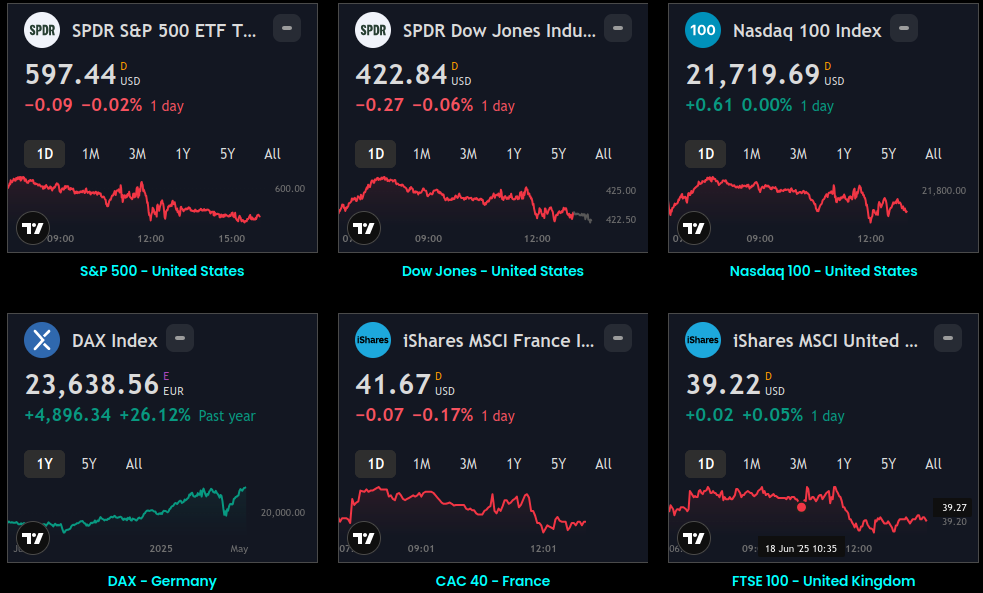
Active Stocks:
 Sage Kakkat
Stocks, ETFs and Funds Screener:
 Sage Kakkat
Forex:
 Sage Kakkat
CryptoCurrency:
 Sage Kakkat
Events and Earnings Calendar:
 Sage Kakkat
This daily briefing is curated from a wide range of reputable sources including news wires, research desks, and financial data providers. The insights presented here are a synthesis of key developments across global markets, intended to inform and spark thought.
No Investment Advice: This content is for informational purposes only and does not constitute investment advice, recommendation, or endorsement.
Timing Note: Each edition is assembled based on the market context available at the time of writing. Timing, emphasis, and interpretations may vary depending on global developments and publishing windows.