
US Stocks open the new month with a mild rally led by software and consumer names rather than chips, as Trump's weekend post canceling a planned Iran strike on the basis of negotiating progress sends oil below $80 for the first time in weeks — though Iran denied being in talks and markets have heard this before — while Palantir headlines a busy earnings week that also features AMD, Disney, McDonald's, and Friday's July jobs report.
- S&P 500 futures rose and Polymarket showed an 86% probability of a higher open, building on Friday's full session gains in which the S&P 500 climbed 1.05% to close at 7,437.63, the Nasdaq added 1.59%, and the Dow gained 1.04%. However, July's final tally was sobering: the S&P 500 fell 0.13% for the month — snapping an 11-year streak of positive July returns — the Nasdaq declined 3.2%, and the Dow eked out a 0.32% gain, with the bulk of the damage concentrated in the chip and AI infrastructure complex. Of the roughly 300 S&P 500 companies that have reported Q2 earnings so far, 85% beat estimates per FactSet, with aggregate profits tracking to grow more than 47% year-on-year — one of the strongest earnings seasons in modern history.
- Trump posted on Truth Social over the weekend that he had canceled a planned attack on Iran "for the future benefit of the WORLD and the survival of a successful and prosperous Iran," subject to rapidly reaching a deal. Israel joined in the commitment. The move sent oil below $80 a barrel for the first time since late June, with WTI falling and Brent retreating sharply in Asian trade. However, Iran's foreign ministry denied it is in active negotiations, and the Schwab morning update noted that "market participants have heard this before," leaving the relief rally measured rather than euphoric. CNN separately noted that oil keeps tumbling even as the Iran war drags on, reflecting a structural oversupply of crude waiting to hit the market once hostilities fully resolve.
- Palantir Technologies (PLTR) rose more than 3% in premarket ahead of its Q2 earnings report after the close, with analysts projecting continued acceleration in US commercial and government AI platform revenue. The stock is one of the clearest beneficiaries of the AI infrastructure buildout in the software layer and will be closely watched for commentary on enterprise AI adoption rates following the July correction. AMD reports Tuesday, followed by Walt Disney (DIS) and Uber (UBER) on Wednesday and Costco on Thursday. Friday's July nonfarm payrolls report is the week's central macro data point.
- Amazon (AMZN) continued to reverberate through the market in premarket, rising further as analysts digested the company's decision to raise its 2026 capital expenditure plan to $220 billion — an extraordinary commitment that, alongside Microsoft's steady capex and Alphabet's $195–$205 billion guidance, means the three largest US cloud providers are collectively committed to spending over $500 billion on AI infrastructure in 2026 alone. Alphabet (GOOGL) rose more than 2% premarket, Microsoft gained about 1.5%, and Meta added over 1% as capital continued to flow back into mega-cap internet platform stocks following July's deleveraging selloff.
- Google separately announced a $15 billion investment in an Anthropic data center in Texas, reinforcing the AI capex supercycle narrative. GameStop (GME) agreed to privately exchange approximately $1.4 billion of outstanding convertible senior notes for Class A common stock in a deal covering $400 million of 2030 notes and $1 billion in other outstanding debt. Tesla (TSLA) Spain sales plunged 81.3% year-on-year to just 131 vehicles in July, though the company's year-to-date Spain sales remain up 19.8%. The S&P Global final July Manufacturing PMI prints at 9:45 a.m. ET and ISM Manufacturing at 10:00 a.m. ET — the first August data points on the economic activity calendar.
- Japan's Nikkei 225 fell 607 points or 0.94% to close at 63,754 on Monday, giving back a portion of Friday's record-breaking relief rally as investors took profits in chip and AI names. The Topix also declined. SoftBank Group and Tokyo Electron retreated from Friday's outsized gains as selling pressure returned to names that had surged 13–15% in a single session. The Bank of Japan's hawkish statement at Friday's meeting — warning for the first time that inflation could overshoot its target and signaling a focus on upside price risks — is adding to uncertainty for Japanese equities given the yen's sharp recovery from 164 toward 160 per dollar on suspected coordinated intervention.
- China's Shanghai Composite fell 22 points to 3,809 as Chinese technology stocks faced dual pressure from Trump's tariffs and competitive anxiety over Alibaba's Qwen3.8-Max model launch — the latest escalation in China's AI model arms race that is driving up competitive pressure on US and Korean AI hardware suppliers. Hong Kong's Hang Seng rose 124 points to 26,009, outperforming the mainland on strength in Chinese internet names. South Korea's KOSPI was modestly lower as the historic 18% single-day Friday bounce gave way to consolidation — the index remains well below its June peak above 9,000 despite the July-end recovery. Australia's S&P/ASX 200 was little changed. India's Nifty 50 was modestly higher.
Global Indices:
 Sage Kakkat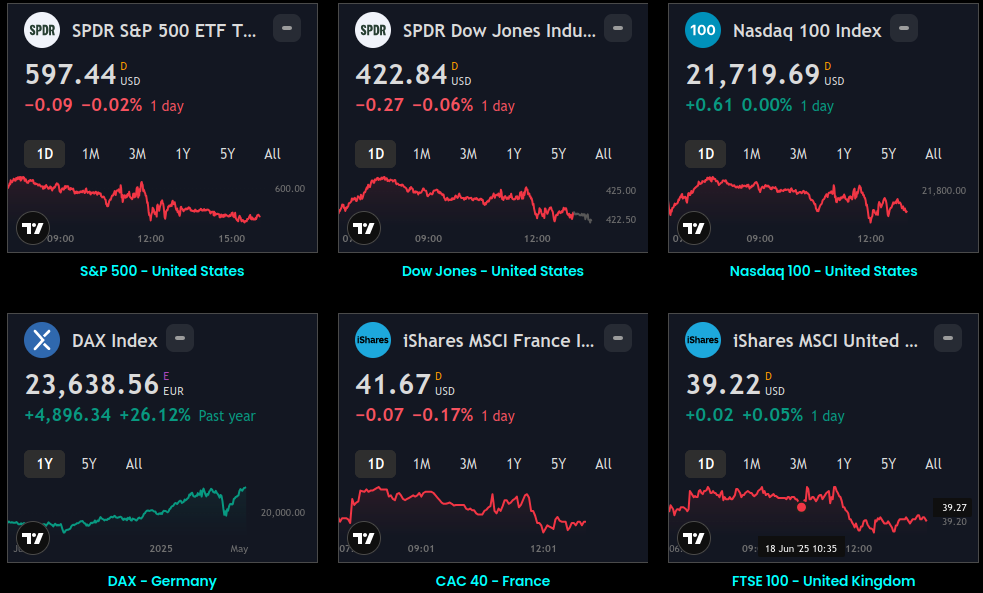
Active Stocks:
 Sage Kakkat
Stocks, ETFs and Funds Screener:
 Sage Kakkat
Forex:
 Sage Kakkat
CryptoCurrency:
 Sage Kakkat
Events and Earnings Calendar:
 Sage Kakkat
This daily briefing is curated from a wide range of reputable sources including news wires, research desks, and financial data providers. The insights presented here are a synthesis of key developments across global markets, intended to inform and spark thought.
No Investment Advice: This content is for informational purposes only and does not constitute investment advice, recommendation, or endorsement.
Timing Note: Each edition is assembled based on the market context available at the time of writing. Timing, emphasis, and interpretations may vary depending on global developments and publishing windows.
