
US Stocks open mixed as SanDisk's forecast miss reignites storage chip selloff fears and Asian tech tumbles for a second straight day, even as Dow futures push higher on Hormuz deal optimism and gold surges 5% to a fresh record — with July's jobs report at 8:30 a.m. ET as the session's defining data point and SpaceX's post-IPO lock-up expiration beginning today adding a fresh overhang to the tape.
- Dow Jones futures gained modestly while Nasdaq-100 futures slipped in premarket, reflecting the same bifurcation that has defined the week — Hormuz deal hope and consumer/industrial strength in one corner, recurring storage chip guidance anxiety in the other. SPY and QQQ were mixed heading into Thursday's open. Wednesday's full session saw the S&P 500 and Dow climb 0.6%, both extending their record-high streaks, while the Nasdaq rose 0.4% — the Nasdaq 100 has now surged 9.3% in four trading days, the biggest four-day rally since April 2025, adding roughly $3.5 trillion in market value.
- SanDisk (SNDK) fell in premarket after reporting Q4 fiscal 2026 revenue of $8.93 billion that beat the top line but issued forward guidance that missed the highest expectations, following the same pattern that punished AMD and SpaceX earlier in the week. Western Digital (WDC) also reported after Wednesday's close, with results similarly met with a cautious market reaction. The storage chip names are the last major AI-adjacent hardware reporters of the season — with Nvidia's report still to come later in August as the final earnings verdict on the AI infrastructure supercycle.
- SpaceX (SPCX) rose 2.87% in premarket as its staggered post-IPO lock-up expiration begins today, releasing a tranche of insider shares into the market. Analysts at Wedbush maintained their Outperform rating with a $190 price target, calling the capex trajectory "consistent with building the AI infrastructure of the next decade." The lock-up releases are structured in phases through September, which will keep some supply overhang on the stock even as the underlying Starlink and AI businesses continue to grow.
- Eli Lilly (LLY) was the week's standout pharmaceutical result — EPS of $8.38 beat the FactSet consensus by $2.37, revenue rose 47.7% year-on-year to $22.97 billion against the $20.69 billion estimate, Mounjaro sales surged 91%, and Zepbound US revenue rose 44%. Lilly raised its full-year 2026 revenue guidance above consensus. Walt Disney (DIS) added nearly 3% after EPS topped consensus by $0.20 on in-line revenue, with entertainment and theme park divisions both performing well and fiscal 2026 guidance reaffirmed. Uber (UBER) fell after reporting lackluster earnings that outweighed a positive robotaxi development — the company's autonomous vehicle progress failed to offset weak platform revenue growth in the quarter. CVS Health beat estimates with EPS of $2.58 versus the $1.85 FactSet estimate on revenue of $106.1 billion versus $100.03 billion expected, raising full-year guidance.
- July nonfarm payrolls print at 8:30 a.m. ET — the week's most consequential macro data point. ADP's private sector jobs report Wednesday showed just 44,000 jobs added in July, the weakest gain in six months and dramatically below expectations, with virtually all growth coming from healthcare-related services and goods-producing industries posting a net loss. The weak ADP print has set up the government payrolls figure as a potential market mover in either direction — a strong number would revive September rate hike fears while a miss would validate the Fed's hold posture and further compress Treasury yields. The benchmark 10-year yield held around 4.44% and the 2-year fell below 4.19% on Wednesday's Hormuz deal progress and soft ADP data.
- Gold surged 5% this week to trade above $4,165–$4,196 an ounce — its biggest weekly gain since the Iran war began — as the combination of AI capex uncertainty, a softer dollar, and falling oil prices drove rotation into the safe-haven metal. Silver rose 3%. Brent crude held near $80 per barrel, with WTI around $76, after a tanker transiting the Strait of Hormuz reported hearing two explosions — with the vessel and crew safe and no environmental damage — adding a reminder that the waterway remains contested even as deal talks progress. Trump said Iran negotiations are "going well." Fed Governor Mary Daly said she supported the decision to hold rates steady at the July FOMC meeting and noted the tariff impact on inflation is beginning to fade.
- Japan's Nikkei 225 fell 0.8% on Thursday as semiconductor stocks came under pressure following SanDisk and Western Digital's after-hours results. SoftBank Group — which had surged nearly 14% on Wednesday — gave back gains. The Nikkei had closed Wednesday at 66,300, up 3.7%, its best session in weeks. The Bank of Japan remains on track for a September rate hike per market pricing, with an LDP lawmaker floating a proposal to sell BOJ-held ETFs to fund a Japan tax cut — a politically sensitive idea that would unwind years of unconventional monetary policy.
- South Korea's KOSPI fell 4% on Thursday, reversing Wednesday's 3.8% gain to 6,598.26, as Samsung Electronics and SK Hynix both dropped sharply on the SanDisk and Western Digital guidance miss. The KOSPI's extraordinary volatility streak continues — the index has now recorded single-day moves exceeding 3% in 34 of the past 43 trading sessions. Fitch Ratings said the volatility poses limited near-term credit risk to Korean sovereign and corporate issuers. Hong Kong's Hang Seng and China's CSI 300 also traded lower, with China's RatingDog July Services PMI coming in well below expectations at its lowest reading since September 2024, holding barely above the 50-point expansion threshold. India's Nifty 50 gained 0.2% and Australia's S&P/ASX 200 rose 0.4% — both continuing to outperform the broader regional selloff for the third straight session.
Global Indices:
 Sage Kakkat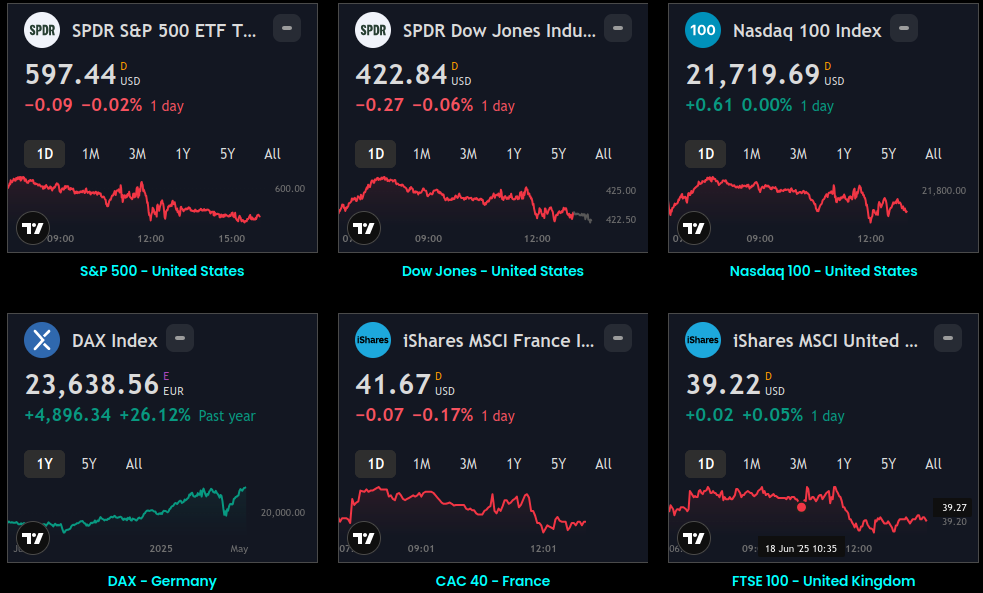
Active Stocks:
 Sage Kakkat
Stocks, ETFs and Funds Screener:
 Sage Kakkat
Forex:
 Sage Kakkat
CryptoCurrency:
 Sage Kakkat
Events and Earnings Calendar:
 Sage Kakkat
This daily briefing is curated from a wide range of reputable sources including news wires, research desks, and financial data providers. The insights presented here are a synthesis of key developments across global markets, intended to inform and spark thought.
No Investment Advice: This content is for informational purposes only and does not constitute investment advice, recommendation, or endorsement.
Timing Note: Each edition is assembled based on the market context available at the time of writing. Timing, emphasis, and interpretations may vary depending on global developments and publishing windows.
