
US Stocks open modestly higher after the July jobs report delivers its biggest miss in years — the economy lost 23,000 jobs versus expectations for an 83,000 gain — slashing September rate hike odds and sending Nasdaq futures up 0.6%, even as Iran's proposal to bar US and Israeli ships from the Strait of Hormuz and a Trade Desk collapse offset gains from Atlassian's 30% surge and Airbnb's beat.
- Dow Jones futures edged up 0.1%, S&P 500 futures gained 0.3%, and Nasdaq-100 futures rose 0.6% after the July nonfarm payrolls report showed the US economy lost 23,000 jobs — far below the 83,000 gain economists expected and following a downwardly revised decline of 20,000 in June, making it two consecutive months of job losses. The unemployment rate ticked down slightly to 4.1% from 4.2%, defying expectations it would hold steady. Markets read the soft data as dramatically reducing the case for a September rate hike, with CME FedWatch showing the probability of a hike at the September meeting falling sharply from 54.7% ahead of the report. Thursday's full session had ended mixed — the Dow fell 0.85% or 479 points to 53,870, snapping a five-day winning streak, while the S&P 500 eased 0.18% and the Nasdaq dipped 0.06%, with eight of eleven S&P sectors ending in negative territory as a rebound in oil prices reignited rate hike fears.
- Atlassian (TEAM) surged 30.25% in premarket — its biggest single-session gain since going public — after the enterprise software company reported Q4 fiscal 2026 results that beat across every metric and issued Q1 guidance well above consensus, with cloud revenue acceleration and AI-powered product adoption cited as the primary drivers. Microchip Technology (MCHP) advanced 8.9% in premarket after forecasting quarterly revenue above estimates, joining a growing list of enterprise tech and software names outperforming the chip hardware complex this earnings season. Airbnb (ABNB) jumped more than 8% in extended trading after reporting stronger-than-expected revenue and earnings. Cloudflare (NET) soared 16% on an upbeat full-year and current-quarter outlook, the third consecutive cloud software name this week to surge on guidance strength.
- Trade Desk (TTD) plunged 27.45% in premarket — its worst single-session decline since going public — after reporting worse-than-expected Q2 financial results and issuing soft Q3 revenue guidance that fell well below Wall Street's already-reduced expectations. The selloff erases months of gains in the programmatic advertising platform and raises fresh questions about whether AI is beginning to disrupt rather than accelerate digital ad spending patterns. DraftKings (DKNG) slipped 3% after falling short of revenue estimates. The 10-year Treasury yield held at 4.67% and the 2-year at 4.24% ahead of the payrolls data, with both expected to fall sharply after the miss.
- Iran released a draft proposal Thursday stating it would bar US and Israeli ships from transiting the Strait of Hormuz and require compensation from what it termed "hostile countries" before allowing transit — a significant escalation in the diplomatic terms even as Iran and Oman were simultaneously continuing negotiations on a framework that would give both countries more control over the waterway. Brent crude gained 3.8% Thursday to end at $82.48 per barrel on the hardened Iranian stance, while WTI traded near $77.52 ahead of Friday's open. The 10-year Treasury yield and oil's renewed climb are now in direct tension — softer jobs data points to rate cuts while energy re-escalation points to higher inflation.
- SoftBank Group (SFTBY) reported fiscal Q1 2027 profit that beat market expectations, driven by a large gain on its stake in Intel and a rise in ByteDance's valuation helping its Vision Fund division — a notable recovery for a fund that has been writing down positions for much of the past two years. The result propelled SoftBank shares in early Friday Tokyo trade even after Thursday's 4.4% decline following Wednesday's 13% surge, underscoring the extraordinary volatility that has defined Japanese AI-linked names throughout July and August. OCBC reported a 22% rise in Q2 profit to a record S$2.2 billion and UOB posted a 10% increase to S$1.48 billion — both Singapore bank results helped by stronger wealth-management fees and robust regional lending activity — keeping Singapore's financial sector a relative pocket of stability in an otherwise volatile regional tape.
- Japan's Nikkei 225 fell 0.7% to close at 65,683 on Thursday, with chip equipment maker Tokyo Electron down 5.5%, Kioxia declining 10.2%, Advantest losing 2.3%, and SoftBank dropping 4.4% — a sharp reversal from Wednesday's 14% SoftBank surge. On Friday morning the Nikkei fell a further 0.7% as investors waited for US payrolls and tracked another rise in oil prices, with the index trading around 65,000. South Korea's KOSPI fell 4.6% Thursday to 6,296 — its decline from the June peak now reaching 31% — with SK Hynix falling 10.4% and Samsung Electronics declining 6.3% on the SanDisk and Western Digital forecast misses. The KOSPI slipped a further 1% Friday morning. China's CSI 300 gained 0.2% on Friday and broader Asia-Pacific shares outside Japan were flat. Australia's S&P/ASX 200 rose 0.5% to a fresh record high of 9,272 on Thursday, continuing its extraordinary resilience — it has posted gains or held flat in 11 of the past 13 sessions while the KOSPI swung 30%+ in both directions. India's BSE Sensex climbed 0.5% to 78,955 on Thursday.
Global Indices:
 Sage Kakkat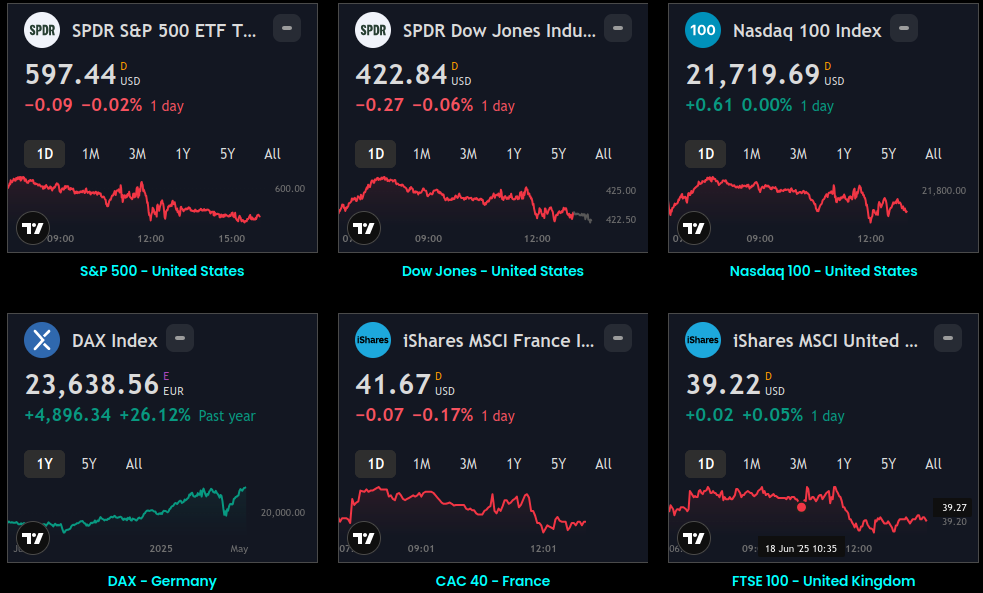
Active Stocks:
 Sage Kakkat
Stocks, ETFs and Funds Screener:
 Sage Kakkat
Forex:
 Sage Kakkat
CryptoCurrency:
 Sage Kakkat
Events and Earnings Calendar:
 Sage Kakkat
This daily briefing is curated from a wide range of reputable sources including news wires, research desks, and financial data providers. The insights presented here are a synthesis of key developments across global markets, intended to inform and spark thought.
No Investment Advice: This content is for informational purposes only and does not constitute investment advice, recommendation, or endorsement.
Timing Note: Each edition is assembled based on the market context available at the time of writing. Timing, emphasis, and interpretations may vary depending on global developments and publishing windows.
