
US Stocks open the week on a cautious, muted note as indexes hover near all-time highs and investors brace for the most consequential inflation data of the summer — July CPI on Wednesday and PPI on Thursday — with oil creeping higher on renewed Hormuz deal uncertainty and Nvidia's earnings report later this month shaping up as the season's final AI verdict.
- Dow Jones futures dipped slightly as crude oil prices gained momentum, while S&P 500 futures edged up 0.12% to around 7,785 and Nasdaq-100 futures rose 0.38% to near 29,896 heading into Monday's open. The major indexes were little changed in early trade, with Polymarket showing a 62% probability of a higher open. Last week delivered the Dow and Nasdaq their strongest weekly performance in months — the Dow and Nasdaq Composite each surged more than 1,300 points week-on-week and the S&P 500 gained over 250 points — driven by the July jobs miss slashing September rate hike odds, Palantir's blowout, and a string of software earnings beats.
- The week's central macro events are Wednesday's July CPI and Thursday's PPI. Economists expect headline CPI to rise just 0.1% month-on-month and core CPI to increase 0.2% — both benign readings that, if confirmed, would further reduce the case for a September Fed hike. A stronger-than-expected reading, however, would revive hike expectations against the backdrop of oil hovering near $84 for Brent. The CME FedWatch tool showed September hike odds falling sharply after Friday's jobs data, with markets now pricing the first hike for November or December at the earliest.
- Vertex Pharmaceuticals (VRTX) gained 7.24% in premarket after beating Q2 earnings estimates, continuing the trend of non-tech names outperforming this earnings season. Hewlett Packard Enterprise (HPE) rose 5.22% after Morgan Stanley upgraded the stock from Equalweight to Overweight, citing AI server demand visibility through 2027. SpaceX (SPCX) rose 3% to $137.12 in premarket after breaking a four-week losing streak on Friday following the end of its post-IPO lock-up period — though retail investors turned net sellers for the first time since the June IPO, with Vanda Research data showing mom-and-pop traders selling a net $4.5 million of SPCX on August 7.
- The week's earnings slate is lighter than recent weeks but carries AI-specific significance: Applied Materials, Cisco, and CoreWeave all report, providing the next data points on AI capital equipment demand and cloud infrastructure revenue before Nvidia's Q2 report — the season's final and most-watched result — due later in August. Goldman Sachs reiterated its bullish equity stance and forecast oil would soften below $70 per barrel once Hormuz flows normalize, while UBS flagged near-term gold risks but maintained its $5,000-per-ounce long-term target.
- Iran said Sunday that a deal with Oman defining new shipping lanes through the Strait of Hormuz is in its final stages — but simultaneously reiterated that the waterway would only fully reopen once the United States met additional conditions, including a halt to all sanctions and withdrawal of military assets from the Gulf region. Iran's Islamic Revolutionary Guard Corps separately reported missile strikes on a tanker off Oman in the Hormuz southern corridor over the weekend, reminding markets that physical shipping disruption continues even as diplomacy advances. Brent crude gained 1.0% to $84.40 a barrel at the open, while WTI added 2.81%. Citi raised its Q3 Brent forecast to $80 a barrel from $75, citing the drawn-out five-month conflict and repeated failed attempts to restore normal Hormuz flows, while keeping its Q4 target at $70 and its 2027 average at $65.
- The Bank of Japan's July meeting summary released Monday showed the BOJ board is split on the pace of rate hikes, with some members arguing for a faster tightening path while others urged caution given global uncertainty. Japan's average cash earnings rose 3.4% year-on-year in June — the 54th consecutive month of nominal wage growth — strengthening the case for a September BOJ rate hike. China's July CPI came in soft, with the PBOC setting its USD/CNY reference rate at 6.7884, above the 6.7379 estimate, suggesting mild capital pressure on the yuan.
- Japan's Nikkei 225 surged 2.1% to close at 66,970.22, led by Tokyo Electron gaining 4.1% and Advantest rising 6.4% as the jobs-miss-driven rate-cut optimism boosted AI and chip-adjacent names. The broader rebound was driven by foreign investors rotating back into Japanese technology names after weeks of selling. South Korea's KOSPI added a more modest 0.7% to 6,299.66 as Samsung Electronics lost 0.4% and SK Hynix fell 0.1%, with analysts noting foreign investors were selling the big chip names to lock in profits and rebalance into defense and financials. MSCI's broadest index of Asia-Pacific shares outside Japan edged up 0.3%. Australia's S&P/ASX 200 was little changed near its record high of 9,272 set Thursday. China's CSI 300 was modestly higher. India's BSE Sensex edged up and Singapore's OCBC and UOB — which both reported record or near-record Q2 profits last week — kept the Straits Times Index resilient.
Global Indices:
 Sage Kakkat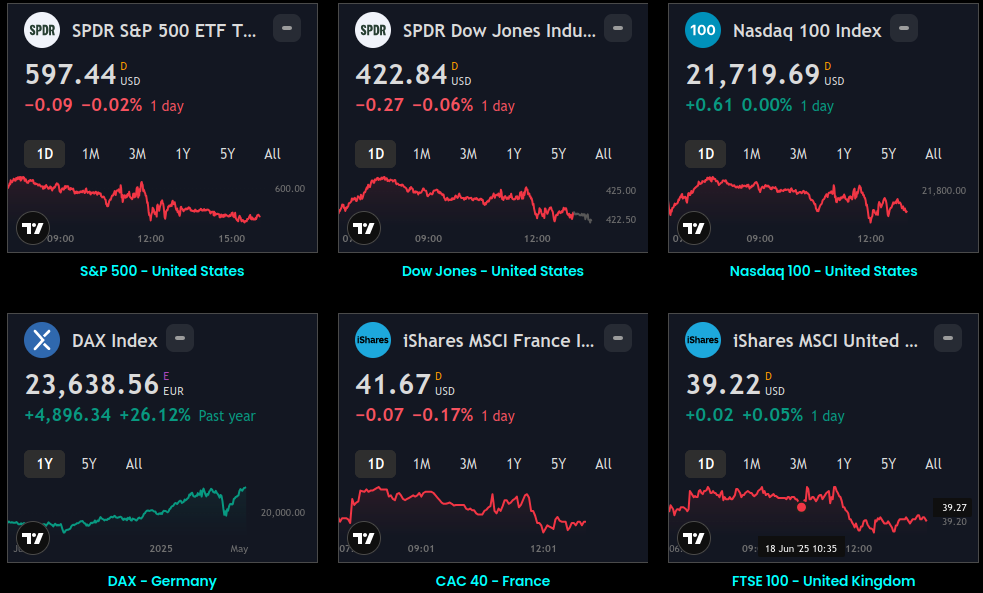
Active Stocks:
 Sage Kakkat
Stocks, ETFs and Funds Screener:
 Sage Kakkat
Forex:
 Sage Kakkat
CryptoCurrency:
 Sage Kakkat
Events and Earnings Calendar:
 Sage Kakkat
This daily briefing is curated from a wide range of reputable sources including news wires, research desks, and financial data providers. The insights presented here are a synthesis of key developments across global markets, intended to inform and spark thought.
No Investment Advice: This content is for informational purposes only and does not constitute investment advice, recommendation, or endorsement.
Timing Note: Each edition is assembled based on the market context available at the time of writing. Timing, emphasis, and interpretations may vary depending on global developments and publishing windows.
