
US Stocks open lower to close out August as Warsh's unexpectedly hawkish Jackson Hole debut pushes September rate hike odds above 60%, oil surges back above $90 on renewed US-Iran strikes, and gold slides $50 — marking the most significant single-session shift in the Fed policy outlook since Warsh took the chair in June, with this week's ISM Manufacturing and Friday's August nonfarm payrolls the two remaining data points that will determine whether the Fed hikes on September 16.
- S&P 500 futures fell 0.2%, Nasdaq-100 futures dropped 0.2%, DAX futures slipped 0.2%, and FTSE 100 futures were flat heading into Monday's open — a broadly risk-off setup as Warsh's Friday speech reverberated through the weekend. The S&P 500 closed Friday at 7,711, down 0.25%, as yields rose and small caps fell in the immediate post-speech selloff. For August, the S&P 500 posted a modest monthly gain despite the Warsh shock, the KOSPI surged 11.5% in its best week of the month, and MSCI's Asia-Pacific index rose 3.1% — snapping two consecutive months of declines.
- Warsh told the Jackson Hole audience on Friday that "while this summer's PCE and CPI readings were better than expected, they do not tell me that underlying trends have meaningfully improved," and that inflation should decline "gradually over a reasonable period" toward the Fed's 2% target — or else "officials need to adjust policy variables." The remarks were interpreted as significantly more hawkish than markets had priced, with Fed funds futures moving from a 33.7% probability of a September hike before the speech to 57.5% immediately after, and to 60.4% by Monday morning. Analysts at JPMorgan, Apollo, and Morgan Stanley said Warsh's emphasis on the 2% target "could be read as an effort to reinforce the Fed's independence and credibility" against Treasury Secretary Bessent's bond-market intervention — potentially putting the Fed and Treasury "at odds" for the first time since Warsh took over. The two-year Treasury yield was at 4.32% in Asia trade, down 2 basis points from Friday's close as Treasuries recovered some losses.
- US forces struck two Iranian rocket launchers near the Strait of Hormuz on Sunday — ending more than five weeks of relative calm — in retaliation for what the Pentagon described as Iranian harassment of commercial vessels in the waterway. The strikes mark the first direct US military action against Iran since late July, resetting the conflict clock and sharply reviving the energy inflation premium that had been gradually deflating. Brent crude surged 2.5% to $90.25 a barrel and WTI climbed 2.8% to $85.73 — both erasing several weeks of decline in a single overnight session. The renewed hostilities also put the September FOMC meeting in a more complicated position, as energy-driven inflation now re-accelerates precisely when Warsh has signaled the Fed is already leaning toward a hike.
- Gold fell to around $4,415–$4,433 an ounce — down roughly $50 from Friday's close — as higher rate expectations reduced demand for the non-yielding asset, even as oil's surge kept the broader inflation-hedge narrative alive. Bitcoin slipped to around $77,500–$78,059. The dollar eased after its strongest single-day gain in two months on Friday following the Warsh speech, with EUR/USD at 1.1578–1.1595 and USD/JPY at 160.17–160.20 — the yen's firmest level since last month's coordinated intervention as BOJ rate hike bets remained elevated at roughly 85% probability for September.
- China's official August Manufacturing PMI came in at 49.6 — above July's 49.2 but still below the 50-point expansion threshold for a second straight month, matching the Reuters poll consensus. The non-manufacturing PMI was also soft. The data confirmed China's manufacturing sector remains in contraction despite some stabilization, adding a demand-side headwind to the global growth picture even as AI-driven semiconductor and capital equipment demand remains robust. The week's US data calendar builds toward Friday's August nonfarm payrolls — with economists expecting a modest recovery to roughly 65,000 jobs — preceded by ISM Manufacturing today at 10:00 a.m. ET, JOLTS on Tuesday, ADP on Wednesday, and ISM Services on Thursday.
- PayPal (PYPL) fell sharply after Bloomberg reported Friday that Stripe and Advent International had abandoned their acquisition pursuit of the company — reversing Thursday's 12% surge and wiping out a significant portion of the week's gains. Marvell Technology (MRVL) dropped approximately 8% on soft forward guidance despite Thursday's blowout results, adding a chip-sector overhang alongside the macro pressure. Gap surged approximately 14% after announcing Michael Francis as Old Navy's new CEO and posting Q2 adjusted EPS of $0.52, beating estimates. Walmart settled the US government's long-running opioid lawsuit over its pharmacies over the weekend, removing a multi-billion dollar legal uncertainty from the retailer's balance sheet heading into the September quarter.
- MSCI's Asia-Pacific equity gauge fell 0.7% in early Monday trade before recovering, with South Korea's KOSPI initially down 1.2% as Samsung Electronics and SK Hynix dragged before reversing to close up 0.2%–0.5% as bargain buyers stepped in and China's CSI 300 rose 0.3% to provide regional support. Japan's Nikkei 225 fell 0.4% to close near 65,900 as the hawkish Warsh surprise and renewed Iran strikes weighed on risk appetite, with chip equipment names Tokyo Electron and Advantest both under pressure. Hong Kong's Hang Seng fell 0.4%–0.7%, with ChiNext declining 1.3% as mainland tech names lagged. Australia's S&P/ASX 200 slipped 0.2%, giving back some of its recent record-high gains as higher bond yields weighed on the interest-rate-sensitive property and consumer sectors, though energy names provided partial offset on the oil surge. Malaysia, the Philippines, and Vietnam were closed for public holidays, reducing regional liquidity. India's Q1 GDP and Germany's preliminary August CPI are due tonight into tomorrow morning.
Global Indices:
 Sage Kakkat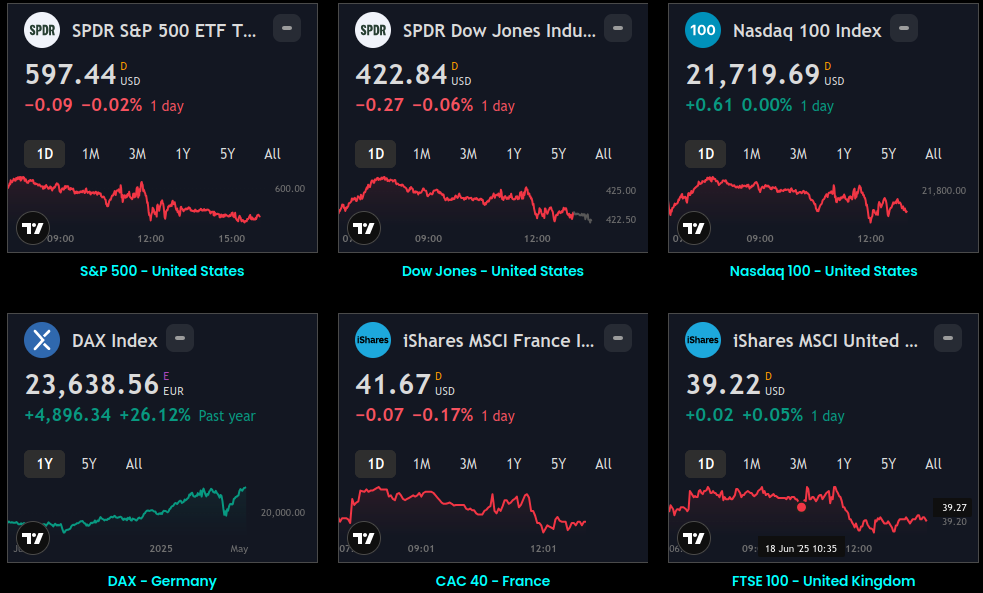
Active Stocks:
 Sage Kakkat
Stocks, ETFs and Funds Screener:
 Sage Kakkat
Forex:
 Sage Kakkat
CryptoCurrency:
 Sage Kakkat
Events and Earnings Calendar:
 Sage Kakkat
This daily briefing is curated from a wide range of reputable sources including news wires, research desks, and financial data providers. The insights presented here are a synthesis of key developments across global markets, intended to inform and spark thought.
No Investment Advice: This content is for informational purposes only and does not constitute investment advice, recommendation, or endorsement.
Timing Note: Each edition is assembled based on the market context available at the time of writing. Timing, emphasis, and interpretations may vary depending on global developments and publishing windows.
