
US Stocks open September under pressure as two oil tankers — one Saudi, one South Korean-owned — were struck by projectiles in the Strait of Hormuz overnight in the latest sign the six-month Iran war is locked in an unbreakable stalemate, pushing Brent above $92, the 10-year Treasury yield to its highest since January 2025, and Dow and S&P 500 futures down 0.5% while Nasdaq futures drop 1.1%.
- Futures tied to the Dow Jones Industrial Average and S&P 500 were recently down 0.5% each while Nasdaq futures fell 1.1% — a risk-off setup as rising oil and yields offset any residual Nvidia earnings momentum from last week. Despite Monday's declines all three major indexes still posted gains for August, extending the Dow's winning streak to five months. Capital.com's Daniela Hathorn said "markets are starting September cautiously, with investors balancing renewed geopolitical uncertainty, elevated bond yields and the latest US economic data," noting the S&P 500 "remains close to record territory, but momentum has softened after a strong summer."
- WTI crude rose 2.4%–2.37% to around $87.79–$88 per barrel — its second straight day of gains since US forces struck an Iranian island in the Strait of Hormuz on Sunday — while Brent traded above $92 per barrel. Trump told Fox News reporters Monday "we're going to hit them hard" in response to Iran's retaliatory strikes on US military targets across the Middle East, keeping the conflict at a boil six months after it began February 28. Two oil tankers attempting to exit the Strait were struck by projectiles in Monday night's exchange, blocking their passage and reigniting fears of a full supply cutoff. Technology analyst Luke Lango viewed the $85 oil and elevated yields combination as a "stuck range rather than a springboard to much higher levels," noting Trump's historical pattern of escalation without full-scale follow-through — and crucially that the macro environment has not deterred hyperscaler AI capex decisions.
- The 10-year Treasury yield hit a new high since January 2025 heading into Tuesday's open, reflecting the combined pressure of Warsh's hawkish Jackson Hole signal — which pushed September rate hike odds to 60.4% — and renewed Iran-driven energy inflation risk. Glenmede's investment strategists wrote "the Fed's focus remains squarely on inflation," adding that a payrolls report landing near consensus would reinforce the view that the timing of any future policy shift hinges on price pressures rather than payroll growth. Gold spot fell 1.61% to $4,377.83 an ounce as rate hike expectations reduced demand for the non-yielding metal. Bitcoin slipped 1.10% to $77,826.20. The US Dollar Index edged 0.13% higher to 99.56.
- JOLTS job openings for July print at 10:00 a.m. ET — the first of four labor market data points this week building toward Friday's August nonfarm payrolls, which economists expect to show a recovery to roughly 65,000 jobs from July's -23,000 shock. The ISM Manufacturing PMI for August and July construction spending also print at 10:00 a.m. ET, alongside the final S&P Global US Manufacturing PMI at 9:45 a.m. — with consensus expecting 53.3 versus July's 53.2. Medtronic (MDT) reported Q1 2027 EPS of $1.39 on revenue of $9.55 billion before the open. Dell Technologies (DELL), Palo Alto Networks (PANW), MongoDB (MDB), and Zscaler (ZS) all report after the close — with Dell and Palo Alto the most closely watched for AI infrastructure spending and cybersecurity demand signals.
- Robinhood (HOOD) rose 2.5% in premarket after Morgan Stanley upgraded the stock, citing structural improvements in its retail brokerage model and expanding crypto and options revenue streams. Walmart separately settled the US government's long-running opioid lawsuit over its pharmacies over the weekend — removing a significant legal overhang — while the company's comparable sales weakness in last week's Q2 report continues to set a cautious tone for consumer-facing names heading into the September quarter.
- Asian markets were broadly lower on Tuesday except South Korea's KOSPI, which bucked the regional trend. Japan's Nikkei 225 fell as chip and AI-linked names came under pressure from the Warsh hawkish signal and rising yields, extending Monday's decline. China's CSI 300, Hong Kong's Hang Seng, Australia's S&P/ASX 200, and India's Nifty 50 all fell as the renewed Iran hostilities and oil surge weighed on energy-import-sensitive economies across the region. European markets were lower in early trading. South Korea's KOSPI was the sole regional outperformer, supported by Samsung Electronics and SK Hynix stabilizing after last week's sharp moves and continued bargain-buying in the large-cap memory names following the KOSPI's extraordinary August recovery. Malaysia, the Philippines, and Vietnam markets were closed for the third straight day on public holidays.
Global Indices:
 Sage Kakkat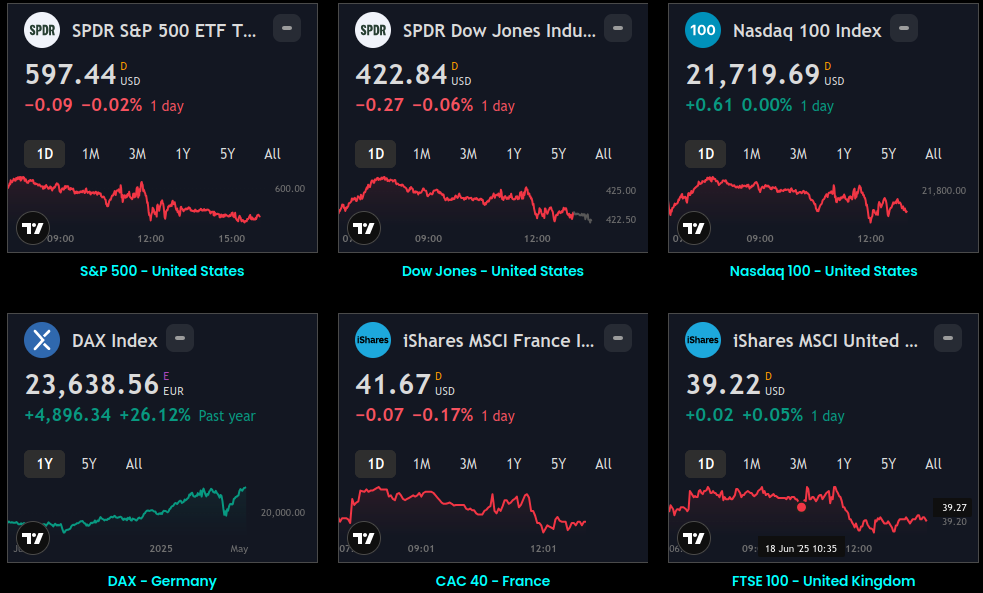
Active Stocks:
 Sage Kakkat
Stocks, ETFs and Funds Screener:
 Sage Kakkat
Forex:
 Sage Kakkat
CryptoCurrency:
 Sage Kakkat
Events and Earnings Calendar:
 Sage Kakkat
This daily briefing is curated from a wide range of reputable sources including news wires, research desks, and financial data providers. The insights presented here are a synthesis of key developments across global markets, intended to inform and spark thought.
No Investment Advice: This content is for informational purposes only and does not constitute investment advice, recommendation, or endorsement.
Timing Note: Each edition is assembled based on the market context available at the time of writing. Timing, emphasis, and interpretations may vary depending on global developments and publishing windows.
