
US Stocks open broadly higher after August nonfarm payrolls smash expectations — 162,000 jobs added versus the 53,000–56,000 consensus — slashing September rate hike odds back toward 50/50 from the near-certainty that had built after Warsh's Jackson Hole speech, even as the strong number revives the inflation-through-wages concern that makes the Fed's September 16 decision the most genuinely uncertain in years, with markets closed Monday for Labor Day.
- Dow Jones Industrial Average futures dipped 48 points or 0.09% to 53,697 before the data landed, S&P 500 futures edged up 4.75 points or 0.06% to 7,759.50, and Nasdaq futures gained 137 points or 0.46% to 29,661.75 in cautious pre-report trading. Thursday's session had delivered a powerful relief rally — the Dow surged more than 600 points or 1.2%, its strongest session since August 4, the S&P 500 rose more than 1%, and the Nasdaq Composite added 1.4% — after Fed Governor Chris Waller indicated he favored leaving interest rates unchanged for now, halving September hike odds from 60% to roughly even money. Futures extended those gains on the jobs beat, with Nasdaq futures leading as the strong labor market reduced recession fears while the non-inflationary composition of the jobs gain — led by food services, local government education, and health care rather than wage-intensive sectors — provided some cover for the Fed to hold.
- The August nonfarm payrolls report showed 162,000 jobs added — the most in five months and dramatically above the Dow Jones consensus of 56,000, the ADP-implied 38,000, and virtually every sell-side estimate. June and July payrolls were revised up by a combined 55,000, partially reversing the 103,000 downward revision from last month and removing the double-dip fear that had emerged from July's -23,000 shock. The unemployment rate held at 4.1%. Employment increased in food services and drinking places by 59,000, local government education by 42,000 — largely reversing the prior month's seasonal distortion — manufacturing by 16,000, and health care by 13,000. Information employment declined 23,000, with computing infrastructure providers, data processing, and web hosting shedding 8,000 positions. Average hourly earnings rose 3.2% year-on-year, in line with the prior month and the 3.1% consensus, providing the critical assurance that the hiring surge is not being driven by wage-price spiral dynamics. CME FedWatch moved September hike odds to roughly 50/50 on the release from the 57–60% that had prevailed entering the week.
- Thursday's session was driven almost entirely by Waller's dovish pivot and Snowflake's 24% surge. Waller, speaking at a financial conference, said he preferred to leave rates unchanged "for now" — a direct counterweight to Warsh's hawkish Jackson Hole speech — making this the most publicly divided Fed in years heading into a rate decision. The S&P 500, Dow, and Nasdaq all posted their best single sessions of the week, with the Nasdaq recovering to within 1% of its all-time high. The S&P 500 is on track for a modest weekly gain heading into Friday, reversing the prior week's losses.
- Lululemon Athletica (LULU) fell in after-hours Thursday after reporting Q2 results that showed slowing comparable sales growth in the Americas — a key concern given the consumer softness flagged by Walmart earlier in August — though international business remained robust. DocuSign (DOCU) gained after reporting results that beat estimates with a raised full-year revenue outlook driven by AI-powered agreement management platform adoption. The week's broader software earnings sweep — Snowflake, GitLab, Salesforce, CrowdStrike, Okta, and Dell all beat and raised — reinforces Schwab's observation that the Equal Weight S&P 500 flagged in August's final days as breadth narrowed, with AI software and infrastructure now carrying the market rather than a broad-based expansion.
- Brent crude held near $95 per barrel and WTI above $90 heading into Friday's open — both remaining well above pre-conflict levels — as no diplomatic progress on the Strait of Hormuz was reported overnight. Trump said the US carried out a "very heavy attack" against Iran on Wednesday, adding the campaign "wouldn't take too long," while Iranian forces continued retaliatory strikes on US facilities across the Gulf region. The September 16 FOMC meeting now sits as the definitive moment that will determine whether the six-month Iran war's inflation legacy forces the Fed's first hike of the cycle — or whether Waller's dovish dissent from Warsh's Jackson Hole framing carries the day. Markets reopen Tuesday September 8 after the Labor Day holiday.
- Japan's Nikkei 225 closed Thursday's session up 0.83% as the yen strengthened following Waller's dovish remarks — with USD/JPY falling toward 158.50 from 160-plus levels — reducing the import inflation pressure that has kept BOJ rate hike expectations elevated. South Korea's KOSPI rose on Thursday, recovering a portion of Wednesday's 4% crash to 6,562.72, as Samsung Electronics and SK Hynix stabilized and the Waller-driven rate-hike repricing filtered through to chip valuations globally. The Kospi has now recorded daily moves exceeding 3% in more than 40 sessions in 2026 — a staggering frequency that South Korea's financial regulator attributed to leveraged retail products in a report released Thursday. China's CSI 300 was modestly positive and Hong Kong's Hang Seng edged higher as Alibaba and Tencent both gained on improved AI-spending sentiment following Snowflake's blowout. Australia's S&P/ASX 200 rose 0.6% as the Waller-driven yield relief boosted interest-rate-sensitive property and consumer sectors.
Global Indices:
 Sage Kakkat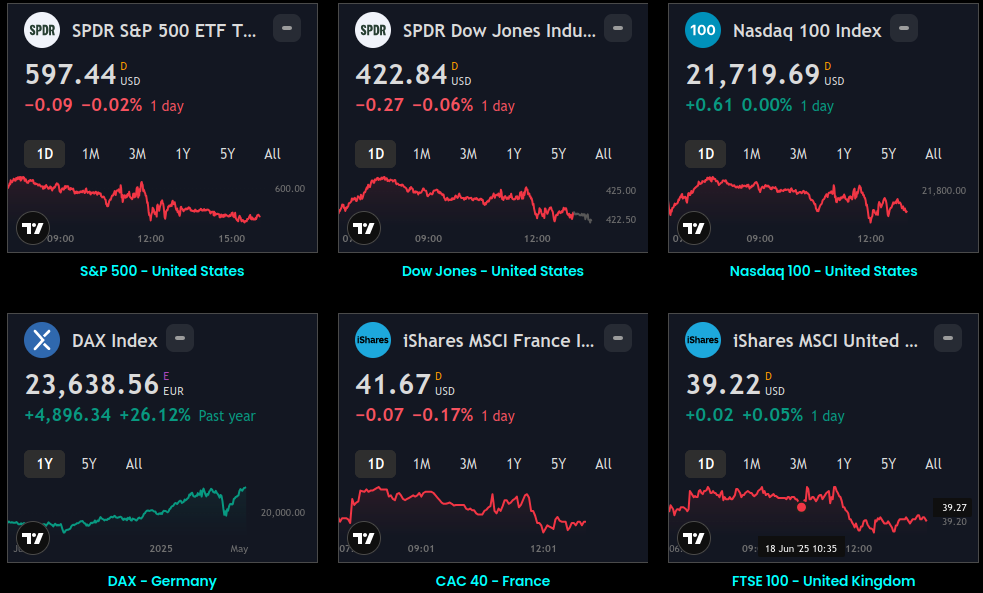
Active Stocks:
 Sage Kakkat
Stocks, ETFs and Funds Screener:
 Sage Kakkat
Forex:
 Sage Kakkat
CryptoCurrency:
 Sage Kakkat
Events and Earnings Calendar:
 Sage Kakkat
This daily briefing is curated from a wide range of reputable sources including news wires, research desks, and financial data providers. The insights presented here are a synthesis of key developments across global markets, intended to inform and spark thought.
No Investment Advice: This content is for informational purposes only and does not constitute investment advice, recommendation, or endorsement.
Timing Note: Each edition is assembled based on the market context available at the time of writing. Timing, emphasis, and interpretations may vary depending on global developments and publishing windows.
