
US Stocks open lower to start the most consequential week of the year as Brent crude surges to a four-month high above $108, Saudi Arabia shuts its East-West pipeline after drone attacks, Houthi rebels seize Yemen's Bab el-Mandeb Strait — threatening a second major oil chokepoint — and Oman postpones the planned Hormuz shipping deal signing, pushing the Fed's September 16 rate hike probability to 86% and sending Dow futures down more than 400 points before the open.
- Dow Jones futures fell 389 points or 0.73% to 53,051, S&P 500 futures dropped 0.5%, and Nasdaq futures slid 1% in early premarket as the worst weekend of the six-month Iran war produced a simultaneous attack on Saudi Arabia's oil infrastructure and a Houthi advance that now threatens both of the world's two most critical shipping chokepoints at once. The S&P 500 closed Friday at 7,592 — down 0.6% on the day and 1.6% for the week — while the Dow dropped 2.5% for the week and the Nasdaq Composite fell. The VIX ended Friday at 17.8, up 25% for the week. Goldman Sachs abandoned its call for no change at this week's FOMC meeting and now expects a 25-basis-point hike, characterizing it as a likely "one and done" move.
- Saudi Arabia shut its East-West pipeline on Sunday as a precaution following drone attacks — the pipeline being the kingdom's key bypass route for oil exports that circumvents the Strait of Hormuz entirely. Saudi export stocks could run out within five to seven days per sources cited by Reuters, marking the most acute near-term supply disruption of the entire conflict. Brent crude rose 3.1% to $107.84 per barrel — extending last week's 9% surge and approaching Thursday's intraday high of $109.97 — while WTI gained 2.8% to $102.85. Brent has now rallied 50% from its July lows and RBC Capital's Helima Croft warned that a full-scale Saudi-Houthi war could push the benchmark to $121.99 by year-end.
- The Houthi takeover of the Bab el-Mandeb Strait — announced over the weekend — is the conflict's most significant geographic escalation since February 28. With Hormuz effectively closed since the war began and Bab el-Mandeb now under Houthi control, more than 40% of global seaborne oil trade is potentially disrupted, with tankers rerouting around Africa adding weeks to voyage times and dramatically increasing shipping costs. A meeting between Iran and Gulf Arab states scheduled for Monday in Oman to discuss a temporary Hormuz shipping corridor was postponed without a new date, dashing the near-term diplomatic hope that had been partially holding oil prices in check through last week.
- The AI trade faces a new and unexpected headwind beyond oil and rates: Anthropic CEO Dario Amodei said AI model progress should be slowed, with OpenAI's Sam Altman agreeing that the industry needs to "pace the frontier," and Elon Musk backing Amodei's view — a remarkable moment of alignment among the three most prominent AI lab leaders. The commentary sent chips, optical networking, data center, and AI power plays broadly lower in premarket, with Nvidia, AMD, Broadcom, TSMC, Lumentum, Coherent, CoreWeave, Nebius, and Palantir all falling across the AI and semiconductor complex. The selling added a second layer of pressure beyond the macro headwinds to the Nasdaq's already-stretched valuation.
- The September 15–16 FOMC meeting is now the week's defining event, with markets pricing an 86% probability of a 25-basis-point hike to 3.75%–4.00% — the first rate increase of the Kevin Warsh era — up from 60–65% entering last week. August CPI came in at 0.4% month-on-month and 3.4% year-on-year on Friday — matching consensus exactly — while August PPI printed at 0.4% month-on-month and 5.3% year-on-year, both hotter than expected. Goldman's overnight call shift to a hike removes the last major voice arguing for a hold, with the only remaining debate being whether Warsh signals it is truly a one-and-done move or leaves the door open to further tightening in November or December. The US is in a pre-FOMC blackout period with no Fed speakers available to guide markets before Wednesday's announcement at 2:00 p.m. ET.
- The Nikkei 225 fell 518 points to 63,492 in Monday's Asian session — its third significant daily decline in a row — as surging oil amplified Japan's energy import cost concerns and dual rate hike expectations from both the Fed and BOJ weighed on growth stocks. The Shanghai Composite dipped 2 points to 3,885 and the Hang Seng rose 111 points to 24,917, a modest regional outlier as Chinese mainland markets maintained relative insulation from Hormuz disruption through Russian and Iranian crude supply channels. South Korea's KOSPI fell 3.6% — its worst session since early September — as Samsung Electronics and SK Hynix both fell sharply on the oil-driven yield surge and the AI pacing commentary. The MSCI Asia-Pacific index outside Japan lost 0.8%. European futures signaled widespread weakness with EUROSTOXX 50 futures down 0.5%, DAX futures slipping 0.4% to 25,440, and FTSE futures easing 0.1%.
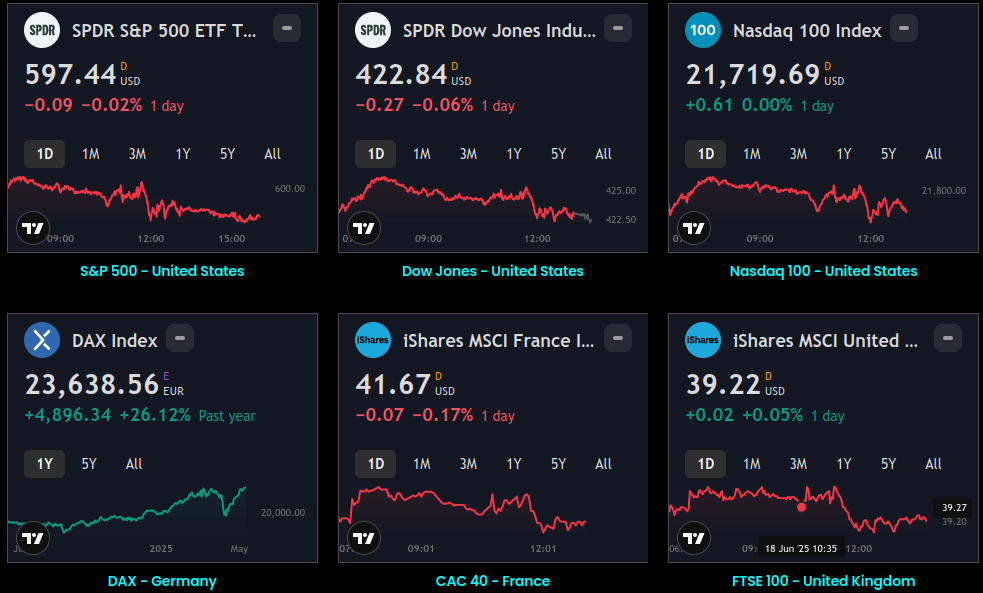
Global Indices:
 Sage Kakkat
Active Stocks:
 Sage Kakkat
Stocks, ETFs and Funds Screener:
 Sage Kakkat
Forex:
 Sage Kakkat

CryptoCurrency:
 Sage Kakkat

Events and Earnings Calendar:
 Sage Kakkat
This daily briefing is curated from a wide range of reputable sources including news wires, research desks, and financial data providers. The insights presented here are a synthesis of key developments across global markets, intended to inform and spark thought.
No Investment Advice: This content is for informational purposes only and does not constitute investment advice, recommendation, or endorsement.
Timing Note: Each edition is assembled based on the market context available at the time of writing. Timing, emphasis, and interpretations may vary depending on global developments and publishing windows.
