
US Stocks open flat to slightly lower as Wednesday's brutal reversal — the worst session in three weeks — lingers in premarket, with the 10-year Treasury yield having surged to 5.11% on scorching September flash PMIs showing multi-year highs in input and output price inflation, even as US stock futures steadied overnight and Costco and Nike headlining tonight's after-close earnings slate as the week's consumer health verdict.
- US equity futures were little changed heading into Thursday's open after Wednesday's session in which the Dow fell 0.68%, the S&P 500 declined 0.75%, and the Nasdaq Composite dropped 1.13% — ten of eleven S&P 500 sectors ending lower, led by communication services, utilities, and consumer discretionary. The move followed September's flash PMI data showing not only strong new orders but multi-year highs in both input and output price inflation — a combination that directly refueled expectations of a second rate hike this year and pushed the 10-year Treasury yield to approximately 5.11%, its highest level since July 2007. Weekly initial jobless claims print at 8:30 a.m. ET alongside August new home sales at 10:00 a.m. ET — with the housing sector already facing 30-year mortgage rates above 7% and now absorbing the additional weight of the Fed's September hike.
- Wednesday's flash September PMI data was the tape's defining shock. S&P Global's Manufacturing PMI showed strong new orders and accelerating input cost inflation driven by energy costs tied to the Iran war, while the Services PMI showed pricing power at multi-year highs — a stagflationary cocktail that CME FedWatch processed into a significant jump in October hike odds. Schwab noted crude directed traffic on Wall Street all day as investors tracked diplomatic progress at the United Nations while awaiting weekly US supply data that showed oil inventories drawing down faster than expected. A weak 7-year Treasury note auction on Wednesday added to bond market pressure, with the 2-year yield also climbing as short-duration investors priced a more aggressive Fed path.
- Costco Wholesale (COST) and Nike (NKE) both report after tonight's close — the week's most important earnings pair for reading US consumer health. Costco investors are focused on membership renewal rates and whether the warehouse giant is seeing any shift in consumer spending habits as mortgage rates top 7% and higher borrowing costs begin to bite. Nike's fiscal Q1 results will be Elliott Hill's second quarterly report as CEO, with the company still in the early stages of a multi-year turnaround — Barclays lowered its Nike price target to $48 from $52 in the past 24 hours, while a major retail partner told TipRanks Nike "remains a very strong brand." Nike also parted ways with Kylian Mbappé after a 20-year partnership, with the French star noting "it was time to change." Darden Restaurants (DRI) reports before the open providing a restaurant sector read. Jabil (JBL) and TD Synnex (SNX) reported results today.
- Micron Technology (MU) slipped 2.1% in premarket to $1,049.56 and Intel (INTC) dropped 2.7% to $119.24 — both under pressure from the yield surge and the AI pacing concerns that have intermittently weighed on chip names since Anthropic, OpenAI, and Musk's September 14 weekend commentary. Copper hit a new record high Wednesday — its prior high earlier in the month coming even as oil soared — with Schwab noting the copper rally reflects tighter supplies in China rather than pure oil price linkage, making it a somewhat independent demand signal for industrial and AI infrastructure activity. Gold was little changed near $4,350 an ounce and Bitcoin held near $86,000.
- The Trump-Xi meeting is Friday's dominant geopolitical event. Trump is scheduled to meet Chinese President Xi Jinping on Friday — with the US-China trade relationship and the Iran conflict's impact on global energy flows both on the agenda. Iran's president addressed the United Nations on Wednesday after Trump threatened Iran in his own UN General Assembly speech the prior day — noting "lower-level talks" were ongoing. The seven-day Hormuz reopening window that a senior Iranian official put on the table Tuesday is now counting down, with no concrete US concessions having been offered publicly. Oil prices rebounded Wednesday after initially falling on the diplomacy headlines, with Brent holding near $99–$100 as uncertainty over Iran talks persisted.
- South Korea's KOSPI was closed Thursday for a public holiday — Chuseok, the Korean harvest festival — removing one of the region's most AI-sensitive benchmarks from the tape for a second consecutive session after Tuesday's closure. Japan's Nikkei 225 returned from its three-day Autumnal Equinox closure Wednesday with a 1.38% gain, its best session in two weeks, before facing renewed pressure Thursday from the 10-year yield's 5.11% spike and oil's rebound. Equity index futures for Hong Kong and Australia both pointed lower Thursday, with New Zealand government bonds also falling in early Asian trading following the Treasury selloff. Australia's September flash PMIs — due overnight Wednesday into Thursday — arrive days before an expected RBA rate hike, with August's services PMI at 53.2 and manufacturing at 52.0 providing the baseline. China's Shanghai Composite was marginally lower at 3,944.87 Wednesday and Hong Kong's Hang Seng fell 0.84% to 24,876.17 as profit-taking in tech names persisted despite Alibaba's chip announcement lifting sentiment in select AI names.
- US Stocks open mildly positive heading into the week's most data-heavy session as a Trump-Iran three-hour meeting on the sidelines of the UN General Assembly — described by Trump as "a very good meeting" — extends Brent crude's decline to a sixth consecutive session, pushing it back below $100 for the first time since early September, pulling the 10-year Treasury yield back below 5%, and sending the Nasdaq Composite to back-to-back record closes even as the Dow and broader cyclical tape lag.
- Dow Jones futures were down 0.32% to 52,112 in premarket but the index is expected to open approximately 250 points above Tuesday's close of 51,863.69, while S&P 500 futures edged down 0.11% to 7,822 and the Nasdaq 100 futures were marginally positive — a mixed setup that reflects continued tech-versus-cyclical bifurcation. Tuesday's full session ended with the Nasdaq Composite gaining 0.45% to 27,244.27 to set a new record close — its second straight record high, the first back-to-back record for the index since June — while the S&P 500 finished essentially flat at 7,764.64 and the Dow fell 0.36% to 51,863.69. The VIX fell 4.44% to 14.21, its lowest reading of the year per Fortune, signaling that options markets have substantially de-risked from September's peak anxiety.
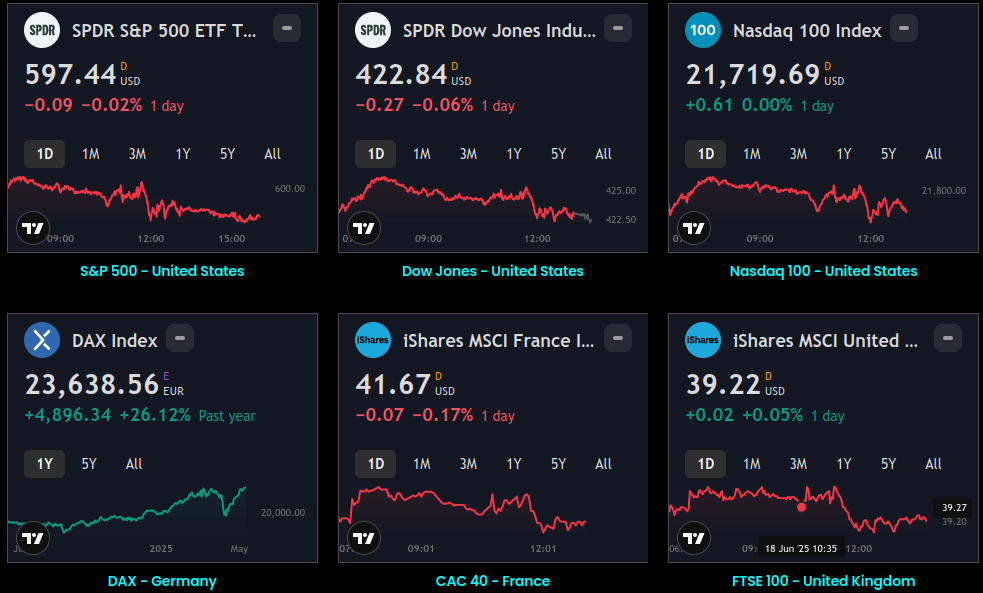
Global Indices:
 Sage Kakkat
Active Stocks:
 Sage Kakkat
Stocks, ETFs and Funds Screener:
 Sage Kakkat
Forex:
 Sage Kakkat

CryptoCurrency:
 Sage Kakkat

Events and Earnings Calendar:
 Sage Kakkat
This daily briefing is curated from a wide range of reputable sources including news wires, research desks, and financial data providers. The insights presented here are a synthesis of key developments across global markets, intended to inform and spark thought.
No Investment Advice: This content is for informational purposes only and does not constitute investment advice, recommendation, or endorsement.
Timing Note: Each edition is assembled based on the market context available at the time of writing. Timing, emphasis, and interpretations may vary depending on global developments and publishing windows.
