
US Stocks open sharply lower as Trump's weekend rejection of Iran's Hormuz proposal — combined with a Wall Street Journal report that he plans to restart bombing Iran after the November 3 midterms — sends WTI crude surging above $96, the 10-year Treasury yield jumping 7 basis points to 5.23%, and Nasdaq 100 futures down 1% heading into the most consequential data week of Q3, with Micron earnings Wednesday and the September jobs report Friday as the twin pillars that will either stabilize or extend the market's worst month since May 2025.
- Dow Jones futures fell 252 points or 0.48% to 51,911, S&P 500 futures dropped 42.25 points or 0.59% to 7,761, and Nasdaq 100 futures tumbled 315.50 points or 1.02% to 30,573 as of the early premarket — a broad risk-off setup driven entirely by the oil and rates shock. The VXX, which tracks short-term VIX futures, jumped 1.58%, while the US Oil Fund (USO) surged 4.44% and the Energy Select Sector SPDR (XLE) gained 1.47% — a stark energy-versus-everything-else bifurcation that has defined the tape for much of September. Intel, AMD, and Micron were all among the hardware names flagged as under pressure at the open.
- Trump told reporters Saturday he had rejected Iran's latest Hormuz proposal as unacceptable, labeling the terms insufficient while boarding Marine One. The Wall Street Journal separately reported he has told advisors he plans to restart bombing Iran after the November 3 midterms — a disclosure that removes any near-term diplomatic safety valve the market had been pricing and extends the geopolitical premium on crude oil, inflation, and rate expectations indefinitely into Q4. WTI crude jumped more than 4% to a session peak of $96.44 per barrel and Brent surged above $100 again as supply disruption risk returned to trading desks. The 10-year Treasury yield hit 5.23% and the 2-year climbed to approximately 4.92% — both at multi-decade highs that are now inflicting measurable damage on mortgage markets, auto lending, and corporate debt refinancing.
- Nvidia (NVDA) approved a $150 billion increase to its share buyback program — taking total authorization to $235 billion, the largest stock repurchase any US company has ever announced — drawing from its record cash balance of over $53 billion built on the back of AI chip demand. The move is designed to signal confidence in the AI demand cycle and provide a mechanical floor under EPS even if revenue growth moderates, though Nasdaq futures are falling anyway as the macro headwinds overwhelm the buyback announcement. Baird upgraded Micron Technology (MU) Monday morning, citing accelerating hardware demand linked to agentic AI workloads — a constructive premarket signal heading into Wednesday's fiscal Q4 earnings report.
- SK Hynix US-listed shares (SKHY) fell 4% in premarket after reports that its US storage subsidiary Solidigm is planning an IPO, raising questions about complex ownership structures and how a Solidigm public listing would affect SK Hynix's consolidated valuation. SpaceX (SPCX) was among the names in premarket focus, as was NIO after Tesla rival reported China delivery data over the weekend showing continued EV demand softness in the world's largest auto market.
- The week's calendar is the busiest since the Fed's September 16 meeting. JOLTS job openings for August print Tuesday alongside September consumer confidence. Wednesday delivers August PCE inflation — the Fed's preferred gauge and the most important inflation read before the October 28–29 FOMC meeting — alongside ADP private payrolls and a second-quarter GDP third estimate, plus Micron's fiscal Q4 earnings after the close and Conagra and Levi Strauss. Nike (NKE) and Accenture (ACN) report Thursday. Friday brings the September nonfarm payrolls report — the last jobs read before the October FOMC meeting — with economists expecting a recovery from August's 162,000 print but watching for any sign that the rate hike is beginning to crimp hiring.
- Carnival Corporation (CCL) reported Q3 2026 results before Monday's open with an estimated EPS of $1.35, providing a read on travel and leisure consumer spending ahead of the holiday season. Jefferies Financial Group (JEF) also reports today. Nvidia's $150 billion buyback authorization means the company could repurchase roughly 4.5% of its outstanding float at current prices — a figure that prompted Michael Burry, in a widely circulated weekend post, to warn that hyperscaler AI capex of $664 billion in 2026 represents a "circular spending regime" that benefits Nvidia most directly through hardware sales that AI companies then use to generate revenue that funds further Nvidia purchases, describing it as potentially the largest single-entity-beneficiary capital cycle in corporate history.
- Asian markets were broadly lower Monday as the Iran rejection filtered through overnight. Japan's Nikkei 225, which had gained 1.26% Friday on Hormuz deal optimism, reversed sharply as crude's 4% surge amplified Japan's energy import cost concerns — the index falling back toward 65,500 from Friday's five-session winning streak close above 66,000. South Korea's KOSPI and the Kosdaq were both closed for the final day of the Chuseok public holiday. China's mainland markets began their Golden Week holiday, with the Shanghai Composite and CSI 300 both closed until October 8 — removing two of the region's largest markets from the tape for the entire first week of Q4. Hong Kong's Hang Seng was open but under pressure. Australia's S&P/ASX 200 edged lower as energy sector gains failed to offset the drag from rate-sensitive property and consumer names. Taiwan's TAIEX was softer as semiconductor names tracked the Nasdaq's premarket decline.
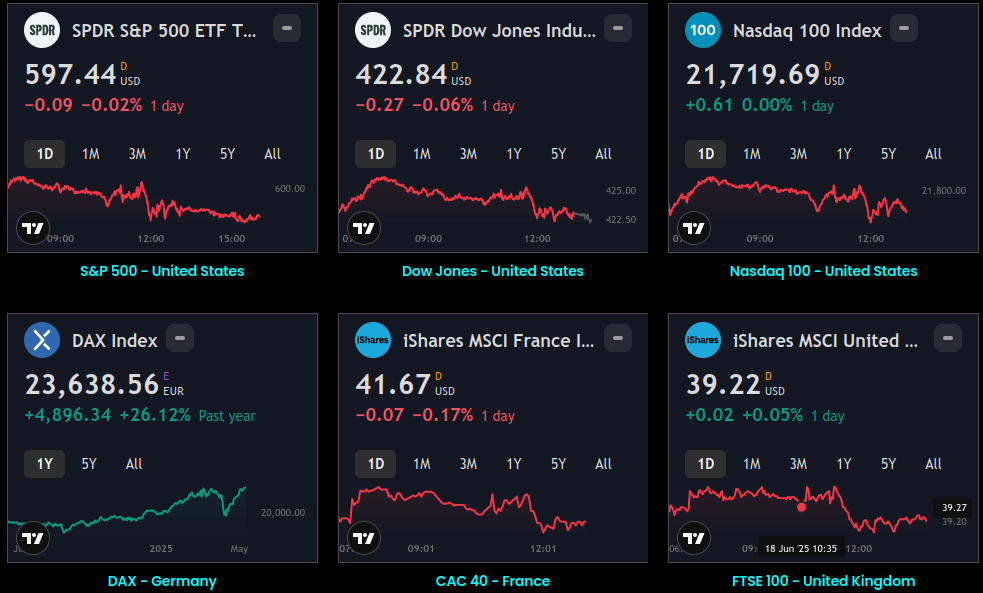
Global Indices:
 Sage Kakkat
Active Stocks:
 Sage Kakkat

Stocks, ETFs and Funds Screener:
 Sage Kakkat
Forex:
 Sage Kakkat

CryptoCurrency:
 Sage Kakkat

Events and Earnings Calendar:
 Sage Kakkat
This daily briefing is curated from a wide range of reputable sources including news wires, research desks, and financial data providers. The insights presented here are a synthesis of key developments across global markets, intended to inform and spark thought.
No Investment Advice: This content is for informational purposes only and does not constitute investment advice, recommendation, or endorsement.
Timing Note: Each edition is assembled based on the market context available at the time of writing. Timing, emphasis, and interpretations may vary depending on global developments and publishing windows.
