
US Stocks open Q4 on a split tape as Micron's extraordinary fiscal Q4 results — revenue of $54.23 billion against $50 billion guidance, EPS of $33.42 versus $31.61 expected, and Q1 guidance of $60–$63 billion implying another 20%+ sequential surge — reinvigorate the AI hardware trade and push the Nasdaq up 0.65%, even as Micron shares paradoxically slip 1% on heavy capex concerns, the Dow lags on 24-year yield highs, and Secretary of State Rubio's expulsion of Iran's UN delegation from New York effectively ends all remaining diplomatic openings.
- S&P 500 futures rose 23.25 points or 0.30% to 7,738 and Nasdaq futures surged 199.50 points or 0.65% to 30,898, while Dow futures were flat at -7 points and Russell 2000 futures slipped 0.4% — a pronounced tech-versus-everything split driven by Micron's blowout and Accenture's 17–21% premarket surge. The 10-year Treasury yield continued its relentless climb, touching 5.306% overnight — a 24-year high — before pulling back slightly ahead of the open. Polymarket showed strong bullish conviction at the open despite the yield headwind, with AI and semiconductor names carrying the broad tape for the second straight session.
- Micron Technology (MU) reported fiscal Q4 results that were extraordinary by any historical measure — revenue of $54.23 billion grew 379.1% year-on-year versus the 351% consensus, EPS of $33.42 beat the $31.61 estimate, and gross margin hit approximately 87%, one of the highest in the company's history. Q1 guidance of $60.0–$63.0 billion in revenue against the $57.4 billion consensus and Q1 EPS guidance of $37.15–$39.15 — both well above expectations — confirmed that AI-driven HBM demand is accelerating rather than plateauing. Micron explicitly stated that memory supply constraint conditions will remain tight through 2028 due to surging AI demand. Yet the stock slipped 1%–2% in premarket — a sell-the-news reaction driven by investor concern over heavy capital expenditure guidance and a slight sequential gross margin decline projected for Q1 to approximately 85.95%–86.25%. Rival memory names SanDisk (SNDK) and SK Hynix (SKHY) were included in the broader AI chip rally even as MU itself underperformed.
- Accenture (ACN) surged 16–21% in premarket — its biggest single-session gain in years — after reporting fiscal Q4 revenue of $18.7 billion versus the $18 billion estimate with new bookings of $22.2 billion, and issuing fiscal 2027 guidance of 3%–6% local-currency revenue growth. UBS said Accenture is on pace to more than double bookings with emerging AI alliances. Cognizant Technology Solutions (CTSH) climbed 7% largely in Accenture's wake, as investors read the consulting firm's AI-driven demand commentary as a sector-wide validation. Software names broadly lifted on IGV's 1.20% Wednesday gain carrying into Thursday.
- Constellation Energy (CEG) gained 2.65% after Amazon agreed to a 20-year power purchase agreement for 190 megawatts of nuclear capacity from Constellation's Calvert Cliffs plant for AI data center needs — the latest hyperscaler-nuclear deal in a growing trend of tech companies locking in carbon-free baseload power for energy-intensive AI workloads. Synopsys (SNPS) rose 2% on its own positive quarterly projection. Trump Media & Technology Group (DJT) jumped over 21% after announcing a merger with TAE Technologies in an all-stock deal valued at over $6 billion. GE Vernova (GEV) gained more than 4% after a Jefferies upgrade to Buy with a price target of $815.
- Nike (NKE) reports fiscal Q1 2027 results after the close — the week's final major consumer earnings verdict and a crucial test of CEO Elliott Hill's turnaround strategy. The stock has fallen roughly 80% from its November 2021 peak and is down approximately 44% year-to-date. The turnaround strategy centers on refocusing on sports like soccer and running, rebuilding wholesale relationships, and rolling out new product lines, but the company has continued to grapple with faltering sales, lack of innovation, and intensifying competition from On Running and Hoka. Nike eventually rose 1.5% during the session after initial premarket weakness ahead of the print.
- September ISM Manufacturing PMI prints at 10:00 a.m. ET — consensus 54.5–55.0 — alongside Construction Spending for August. The ISM data is the last manufacturing activity read before Friday's September nonfarm payrolls at 8:30 a.m. ET — the week's most consequential data point — with consensus at approximately 84,000 jobs. Final September core PCE came in at 3.0% year-on-year versus the 3.3% estimate — a significant downside surprise that Saxo noted was "cooler than expected" and that trimmed October hike odds materially, while Q2 GDP was revised up to 2.2% annualized from 2.0% on stronger investment, consumer, and government spending. Initial jobless claims fell to 197,000 — the fourth straight weekly decline — providing further evidence that the labor market remains firm even as hiring has slowed.
- Secretary of State Marco Rubio ordered Iran's UN delegation to leave New York — a diplomatic expulsion that effectively ends all remaining informal back-channel contact between the two countries and removes the last diplomatic safety valve that markets had been pricing. Oil was little changed initially as the move had been partially anticipated after Trump's weekend rejection of Iran's Hormuz proposal, but the formal expulsion removes any near-term path to resumption of talks ahead of November's midterms, when Trump has reportedly told advisors he plans to restart bombing.
- Japan's Nikkei 225 surged 2,203 points or 3.1%–3.3% to 68,840–68,957 — a six-week high and the index's strongest single session since the post-FOMC relief rally in mid-September — led by Advantest gaining nearly 8%, Tokyo Electron approximately 5%, Kioxia 4.2%, and SoftBank Group among the standout performers. Japan's September Tankan showed big manufacturers' sentiment at +24–+26 for large manufacturing DI, its strongest reading since 2018, while the September Manufacturing PMI rose further. The Nikkei is now up 32.6% year-to-date and 49.8% over the past 12 months — one of the best-performing major global stock markets of 2026.
- South Korea's KOSPI gained 0.9%–2% as Samsung Electronics rose 2.79% and SK Hynix jumped 3.21%, both riding the Micron validation of AI memory demand into Q4. Taiwan's TAIEX hit a record intraday high. South Korea's Customs Service reported that cumulative exports for the first nine months of 2026 surpassed $800 billion for the first time in Korean history. Mainland China's Shanghai Composite and Hang Seng were both closed for China's Golden Week National Day holiday, which runs through October 7 — removing significant regional liquidity from the Asian tape for the entire first week of October. Australia's S&P/ASX 200 was mixed. Singapore's Straits Times Index fell 0.7% for a second straight session, with Venture Corp the worst-performing blue chip.
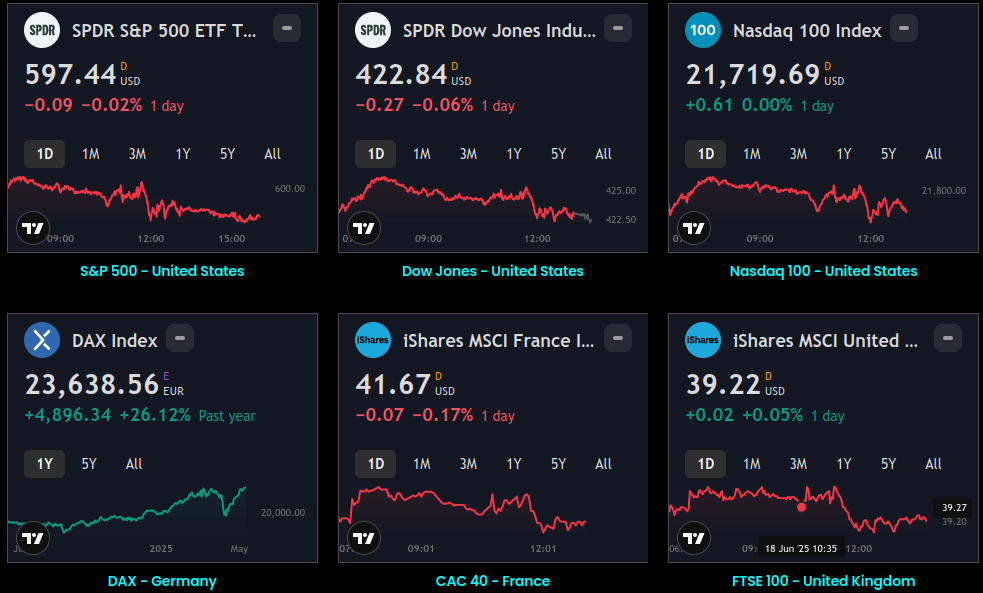
Global Indices:
 Sage Kakkat
Active Stocks:
 Sage Kakkat

Stocks, ETFs and Funds Screener:
 Sage Kakkat
Forex:
 Sage Kakkat

CryptoCurrency:
 Sage Kakkat

Events and Earnings Calendar:
 Sage Kakkat

This daily briefing is curated from a wide range of reputable sources including news wires, research desks, and financial data providers. The insights presented here are a synthesis of key developments across global markets, intended to inform and spark thought.
No Investment Advice: This content is for informational purposes only and does not constitute investment advice, recommendation, or endorsement.
Timing Note: Each edition is assembled based on the market context available at the time of writing. Timing, emphasis, and interpretations may vary depending on global developments and publishing windows.
