
US Stocks surge broadly after September nonfarm payrolls dramatically undershot forecasts — 29,000 jobs added versus the 84,000–90,000 consensus and a 4.2% unemployment rate versus the expected 4.1% hold — slashing October Fed rate hike odds from roughly 38% to near 20% in minutes, sending Dow and S&P 500 futures up 0.8% and the 10-year Treasury yield falling from 5.23% toward 5.18%, as Nike's post-close earnings beat and the AI chip rally's momentum from Micron's blowout carry the tape into the first positive weekly close in four weeks.
- Dow Jones futures rose 0.8% and S&P 500 futures jumped 0.8% in the immediate post-report surge, with Nasdaq-100 futures gaining 0.8%–1.0% as the payrolls miss was broadly read as removing the near-term rate hike threat that had dominated September's tape. Before the data, futures had already pointed to a green open — Nasdaq +0.6%, Dow and S&P +0.3%, Russell 2000 +0.5% — as Nike's after-close Thursday beat and Micron's ongoing reverberations provided pre-report support. The 10-year Treasury yield moved lower to 5.18% from near 5.23% on the release — a meaningful pullback from the 24-year highs hit earlier in the week.
- The September nonfarm payrolls breakdown told a stark story: private payrolls added just 46,000 jobs versus the 90,000 expected, with professional and business services losing 9,000, financial activities shedding 7,000, and information losing 10,000 — the knowledge-economy sectors most directly exposed to the rate environment showing the clearest deterioration. Healthcare added 16,700, transportation and warehousing gained 7,600, and retail trade added 5,800, keeping the headline from going negative. Government payrolls fell 17,000 — the largest monthly government job loss since early 2025. Average hourly earnings data was closely watched for wage inflation signals ahead of the October FOMC meeting.
- Nike (NKE) posted an earnings beat after Thursday's close — reporting fiscal Q1 2027 results that topped Wall Street estimates — a welcome reversal for a stock that has fallen roughly 80% from its November 2021 peak and 44% year-to-date. CEO Elliott Hill's turnaround strategy centered on soccer and running refocus, wholesale relationship rebuilding, and new product rollouts showed early-stage traction. The stock was rising into Friday's open. ON Semiconductor (ON), First Citizens BancShares (FCNCA), and Western Digital (WDC) were also among Friday's notable premarket movers.
- The October 28–29 FOMC meeting is now the dominant forward event. CME FedWatch showed October hike odds at approximately 38% entering the week — after cooling from 70% on the back of softer PCE — and the jobs miss has reduced them further toward 20%, a level that de facto removes October from live consideration. New York Fed President John Williams had already commented Tuesday that he saw "no urgency" for further action, and Minneapolis Fed President Kashkari had penciled in one more hike this year and another in 2027 — but the sequential labor market deterioration (June +31,000, July +21,000, August +162,000, September +29,000) reinforces the view that the Fed's September hike may prove to be the last of this cycle if momentum continues to fade.
- Factory orders for August print at 10:00 a.m. ET. Dallas Fed President Lorie Logan is scheduled to speak later in the session — the final Fed communication before the October meeting blackout period begins next week. ISM Services PMI is on Monday's calendar, providing the week's last activity read before earnings season begins in earnest with the major banks in mid-October.
- Japan's Nikkei 225 closed Thursday at 68,956.72 — up 3.3% for the session and 2.93% for the week, its third consecutive weekly gain. BOJ policymakers' minutes released Thursday showed a broadening internal discussion about scope for faster rate hikes, which sent the yen weaker to approximately 157.95 per dollar as markets concluded the BOJ's September hike to 1.25% may not be the end of tightening. The Nikkei fell 0.17%–1.08% on Friday as oil climbed on Iran concerns and profit-taking followed Thursday's surge, but the weekly gain remained intact. Japan's jobless rate edged higher to 2.5% for September, a modest deterioration.
- South Korea's KOSPI rose 2.0% to 6,971.35 Thursday — a significant recovery driven by Samsung Electronics and SK Hynix both benefiting from Micron's validation of AI memory demand — and closed the quarter down 18.8%, one of the world's worst-performing major indexes in Q3 despite its year-to-date resilience. Equity index futures for South Korea and Taiwan pointed to losses at Friday's open as oil climbed on fresh Iran escalation fears following Rubio's expulsion of Iran's UN delegation. Taiwan's TAIEX was also set to open lower after hitting a record intraday high Thursday.
- Mainland China and Hong Kong both remain closed for Golden Week National Day holiday through October 7 — removing two of Asia's largest equity markets from the tape for the full first week of Q4. MSCI's broadest index of Asia-Pacific shares outside Japan was down 0.2% heading into Friday's session per Reuters, while Australian ASX futures edged modestly higher. Oil prices climbed on Friday as the expulsion of Iran's UN delegation hardened the conflict's apparent trajectory, pushing Brent back above $100 and WTI above $93 in early Asian trade — an oil move that partially offsets the rate relief from the jobs miss and keeps the inflation picture unsettled heading into Q4 earnings season.
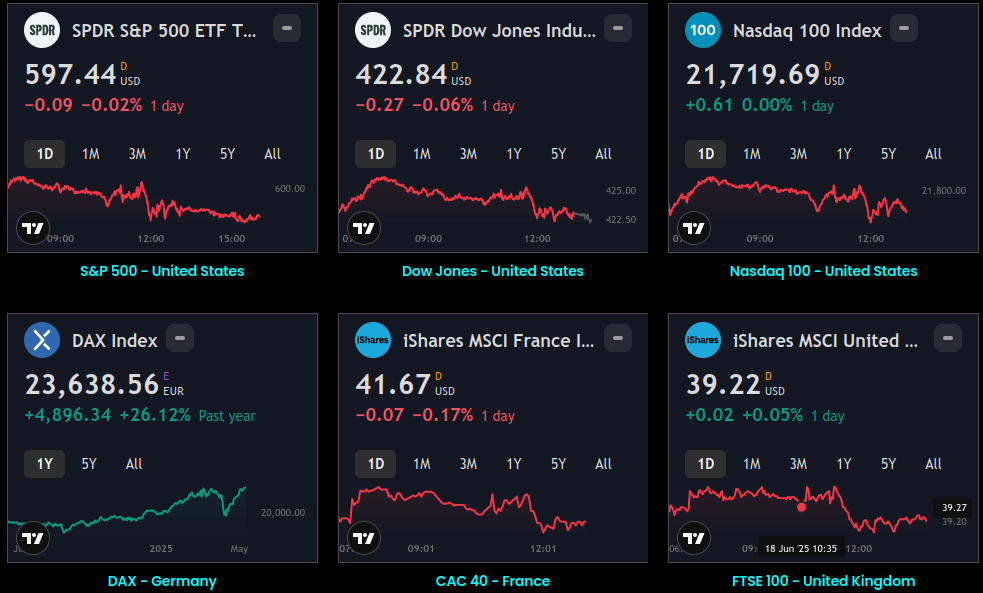
Global Indices:
 Sage Kakkat
Active Stocks:
 Sage Kakkat

Stocks, ETFs and Funds Screener:
 Sage Kakkat
Forex:
 Sage Kakkat

CryptoCurrency:
 Sage Kakkat

Events and Earnings Calendar:
 Sage Kakkat
This daily briefing is curated from a wide range of reputable sources including news wires, research desks, and financial data providers. The insights presented here are a synthesis of key developments across global markets, intended to inform and spark thought.
No Investment Advice: This content is for informational purposes only and does not constitute investment advice, recommendation, or endorsement.
Timing Note: Each edition is assembled based on the market context available at the time of writing. Timing, emphasis, and interpretations may vary depending on global developments and publishing windows.
