
US Stocks open higher to close out the week as oil retreats near $103 after Trump pledged not to strike Iran before the November midterms, tech rebounds from Thursday’s OpenAI-driven selloff, and SpaceX’s $8 billion acquisition of nationwide 800 MHz spectrum from Grain Management reshapes the US telecom landscape in a single overnight announcement — sending T-Mobile down 13%, AT&T down 11%, Verizon down 10%, and European carrier Deutsche Telekom down 7.3% while lifting tower operators American Tower, Crown Castle, and SBA Communications 6%–10% and pushing SpaceX shares up 3%–4%.
- S&P 500 futures gained 0.3%–0.4% to approximately 7,847, Nasdaq 100 futures rose 0.8%–233 points to approximately 31,512, and Dow futures were flat to modestly positive at 51,563 as of early premarket — a recovery setup after Thursday’s mixed close in which the Dow and Russell 2000 eked out gains while the S&P 500 and Nasdaq fell on the OpenAI revenue shortfall and oil-driven yield pressure. Capital.com’s Daniela Hathorn noted “futures are moving higher this morning, suggesting investors remain willing to buy into weakness.” Treasury yields pulled back from Thursday’s 5.36% 24-year high to approximately 5.24%–5.32%, providing partial relief for growth stocks. University of Michigan’s preliminary October consumer sentiment prints at 10:00 a.m. ET — consensus 47.6 versus the prior 48.1.
- SpaceX (SPCX) is the week’s single biggest structural market story. Grain Management’s October 8 announcement confirms that SpaceX will acquire a nationwide portfolio of up to 14 megahertz of paired 800 MHz low-band spectrum for approximately $8 billion in cash — the same spectrum band that T-Mobile, AT&T, and Verizon built their 4G coverage networks on, giving SpaceX the foundation to turn Starlink Mobile from a satellite complement into a full-featured terrestrial mobile competitor. FCC approval is still required, and the agency is separately scheduled to vote on making an additional 482 megahertz available for satellite-to-phone services on October 29 — a vote that could also benefit Amazon’s Project Kuiper. Tower operators rose sharply on the thesis that SpaceX’s network build-out would require terrestrial infrastructure even as it disrupts the incumbents. Apple (AAPL) was also lower on reports it is cutting iPhone 18 production orders.
- Delta Air Lines (DAL) fell 3%–4% in premarket — its first earnings miss in two years — after reporting Q3 adjusted EPS of $1.72 on revenue of $17.59 billion, both missing LSEG estimates of $1.75 and $17.67 billion respectively. Delta cut its full-year earnings outlook and slashed its free cash flow guidance to $2.5 billion from as much as $4 billion projected in July, citing persistently high fuel costs. The Q4 guidance also came in below analyst estimates. Delta’s refinery operation — designed to give it a cost advantage in jet fuel — was insufficient to offset the sustained $90-plus per barrel oil environment created by the Iran war. The miss is the first real-world evidence of how sustained high energy prices are beginning to crack corporate profit forecasts outside the tech sector — and a preview of what higher fuel cost assumptions may mean for next week’s bank earnings season.
- Humana (HUM) surged 14%–16% — one of the day’s largest single-stock moves — after CMS released its 2027 Medicare Advantage Star Ratings showing 95% of Humana’s Medicare Advantage members enrolled in plans rated four stars or higher, up dramatically from 20% in 2026, with 42% in 4.5-star plans. The ratings affect 2028 bonus payment eligibility and are a critical annual catalyst for managed care economics. Alignment Healthcare (ALHC) plunged after its flagship California plan dropped to 3.5 stars from a prior 4-star rating. Clover Health (CLOV) surged alongside Humana.
- Trump told reporters Thursday he would not attack Iran before the November 3 midterms — a pledge that pulled Brent crude below $103 from its overnight high near $104 and gave oil-sensitive stocks some breathing room into the weekend. The pledge is effectively a 25-day diplomatic pause, but it removes the most acute binary risk — a sudden large-scale strike — from the market’s immediate calculus. The Pentagon readiness orders remain active and no diplomatic progress has been confirmed. CME FedWatch shows October hike odds at 19% and December at 84% following the hawkish FOMC minutes — with October 13’s bank earnings and next week’s September CPI the next two pivots on the rate path.
- Japan’s Nikkei 225 was little changed at 69,030.92 on Friday morning — barely budging from Thursday’s 1.42% decline to 69,042 — while the broader Topix rose 0.33% to 4,104.81 as financial and materials stocks outperformed. The Nikkei closed Friday’s full session near 68,512, down approximately 0.7% for the day but still up roughly 2% for the week — its third consecutive weekly gain from the historic October 6 close above 70,000. Hong Kong’s Hang Seng jumped 1.4%–425 points to 24,211 in its last hour of trade as Chinese mainland investors continued to reposition following the Golden Week holiday return Wednesday. Mainland China’s CSI 300 advanced 0.16% to 4,317.26, continuing its mild post-holiday stabilization. India’s Sensex was near 72,325.92 — lower on the week following the RBI’s surprise rate hike Thursday to 5.50%.
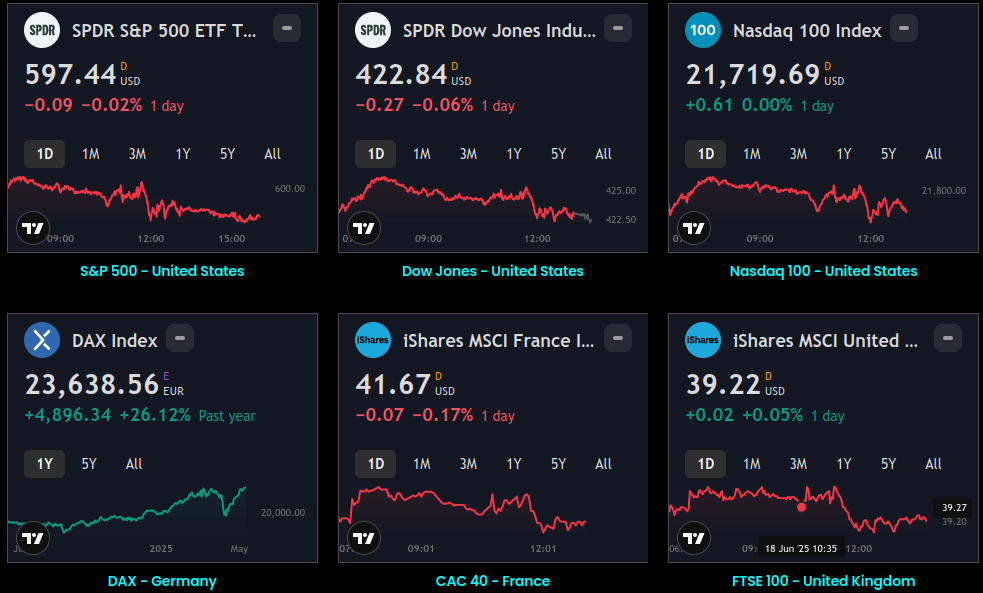
Global Indices:
 Sage Kakkat
Active Stocks:
 Sage Kakkat

Stocks, ETFs and Funds Screener:
 Sage Kakkat

Forex:
 Sage Kakkat

CryptoCurrency:
 Sage Kakkat

Events and Earnings Calendar:
 Sage Kakkat

This daily briefing is curated from a wide range of reputable sources including news wires, research desks, and financial data providers. The insights presented here are a synthesis of key developments across global markets, intended to inform and spark thought.
No Investment Advice: This content is for informational purposes only and does not constitute investment advice, recommendation, or endorsement.
Timing Note: Each edition is assembled based on the market context available at the time of writing. Timing, emphasis, and interpretations may vary depending on global developments and publishing windows.
