
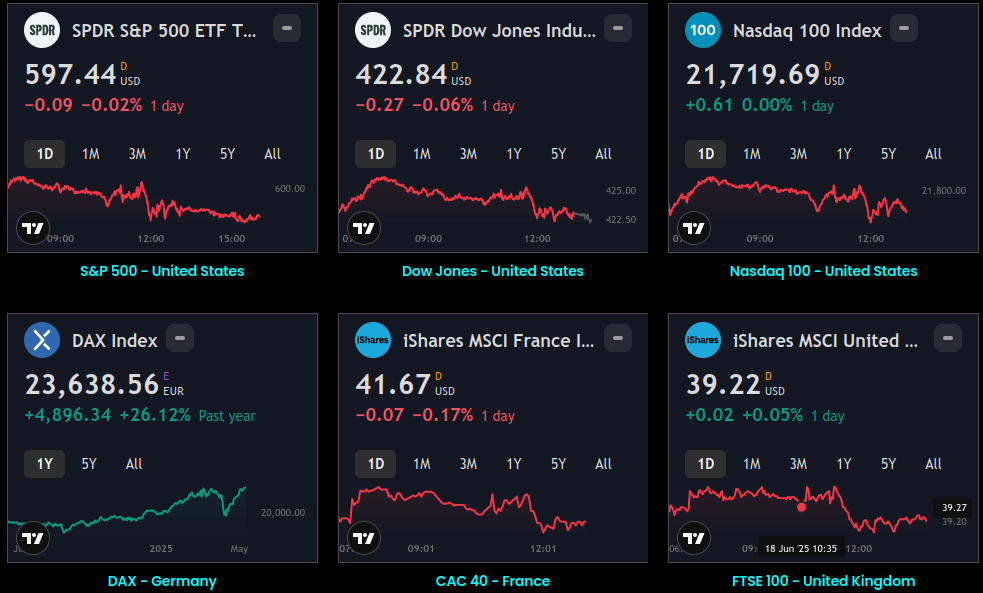
US Stocks closed Friday at their worst weekly levels since June as a historic eight-session rout in the Philadelphia Semiconductor Index — the longest losing streak since 2008 — finally met its oil counterpart, with Brent touching $110 for the first time since May, the two forces together delivering the Nasdaq's worst week since April 2025's tariff shock and raising the central question that will define Q4: whether the AI buildout's debt financing model is structurally sound at 5% Treasury yields and $110 oil simultaneously.
- The S&P 500 fell 84.62 points or 1.09% to 7,659.44, the Nasdaq Composite sank 572.99 points or 2.14% to 26,140.03, and the Dow fell 175.28 points or 0.34% to 52,002.41. For the week: the Nasdaq lost 4.5% and the S&P 500 dropped 1.9% — both their worst weekly performances since June — while the Dow gained 0.67% for its second straight weekly advance, its best back-to-back since early August. The Russell 2000 fell 3.0% on the week. The SOX semiconductor index fell 3.83% Friday for its eighth consecutive losing session, the longest losing streak since 2008, bringing the eight-session drawdown to more than 13% and eliminating roughly $2 trillion in semiconductor market cap. Short sellers accumulated an estimated $32 billion in gross paper profits over the run. The Nasdaq 100 lost 5.5% for the week — its worst since the April 2025 tariff shock.
- Friday's chip names fell in near-perfect rank order of AI trade exposure: AMD fell 6.0% and lost 18.6% on the week, Intel dropped 5.8%, Micron slid 5.6% and 14.6% on the week despite reporting the week prior that its 2027 HBM capacity is fully sold out, Broadcom lost 4.5% on a KeyBanc note flagging MediaTek's expanding role in Google's TPU programme and cancelled orders on Meta's custom-chip roadmap, Marvell fell 5.56%, and optical names Coherent and Ciena each lost 6–7%. Nvidia was again the relative safe haven, slipping just 1.43% — preserving its position as the only name the market still views as a pure-demand beneficiary with no substitution threat. The AI selloff spread from chips into software Friday, with software falling 4.8% and CoreWeave losing another 12% for a total of 25% on the week as its junk-rated bonds sank to distressed levels, signaling that investors are no longer willing to extend the benefit of the doubt on AI infrastructure debt.
- The week's macro argument shifted from "how big is AI demand" to "can anyone earn sufficient returns on the capital being deployed." The Morgan Stanley call cutting its 2026 AMD AI GPU shipment forecast by 75% to 600,000 units versus Nvidia's estimated 8.1 million — a 13x gap — and slashing 2027 from 2.7 million to 1.3 million versus Nvidia held at 7.5 million was the single most destructive analyst note of the week, citing CUDA ecosystem lock-in, networking integration, and TSMC advanced-packaging allocation as structural moats that no competitor is closing. Fed Chair Kevin Warsh spoke at the IMF meetings in Bangkok Thursday night but gave no signal on whether further tightening is needed — a deliberate ambiguity that initially eased October hike odds but provided no lasting relief to rate-sensitive long-duration tech.
- Oil's second shock of the week hit Friday afternoon and kept stocks at their lows. Brent rose 3.7% to $109.86, touching $110 intraday, on fears that Ukrainian strikes on Russian energy assets could disrupt the Russia-diesel supply Trump had waived into the US market the prior Monday — itself an improvised attempt to offset Hormuz-driven supply pressure — and on reports of a possible congressional block of that same waiver. With the waiver now in political jeopardy and the Hormuz closure still intact, energy was the week's lone winning sector: Exxon Mobil gained 2.5% and Chevron added 2.6% Friday. The defensive rotation elsewhere was equally stark — the S&P 500 equal-weighted index had its best week versus the technology-weighted benchmark since 2009, with UnitedHealth up 5.28%, Nike up 5.21%, Home Depot and Walmart each up over 4%, and the S&P 500 healthcare sector closing at a record.
- Asian markets staged a partial recovery Friday after Thursday's session had been brutal across the board. Thursday saw South Korea's KOSPI plunge 7.6% — its worst single session since 2008, with circuit breakers temporarily halting trading as the index fell below 5,600 — with SK Hynix losing 11% and Samsung Electronics dropping 9.5%. Japan's Nikkei 225 fell 4.9% Thursday. On Friday, markets reversed: Japan's Nikkei 225 gained 1.39%–1.85% to close at approximately 65,324–65,619 as chip equipment names Tokyo Electron and Kioxia bounced 2.8% and 3.2% respectively and SoftBank gained 1.7%. South Korea's KOSPI rose 2.05% to 5,668.05 — snapping its own seven-session losing streak — as Samsung Electronics climbed 4.2% and SK Hynix gained 3.5%, partially reversing Thursday's carnage. For the week, the KOSPI dropped 14.5% — its worst weekly performance since October 2008 — as Samsung and SK Hynix lost approximately 20% and 25% respectively. In June the KOSPI was up 116% year-to-date; it has since given back more than a third of those gains.
- Hong Kong's Hang Seng rose 1.2% to 24,353.69 Friday, recovering from Thursday's 1% decline, while China's Shanghai Composite advanced 1.0% to approximately 3,742–3,808 as the tech selloff eased and domestic investors responded to State Council stimulus signals announced during the week. Australia's ASX 200 climbed 1.1% to 8,812.90 and India's Nifty 50 edged 0.2%–0.5% higher. Indonesia's Jakarta Composite Index was Friday's outlier in the opposite direction, plunging more than 10% after MSCI warned that Indonesia's emerging-market classification was no longer appropriate — a separate and idiosyncratic shock that had nothing to do with the AI selloff but added to a global-risk-repricing week. Taiwan's TAIEX recovered modestly as TSMC closed down just 0.8% despite Thursday's post-earnings selloff suggesting the market is beginning to separate the company's fundamental reality — sixth straight quarter of record profit — from the short-term financing-cost de-rating applied to the broader AI complex.
Global Indices:
 Sage Kakkat
Active Stocks:
 Sage Kakkat
Stocks, ETFs and Funds Screener:
 Sage Kakkat
Forex:
 Sage Kakkat

CryptoCurrency:
 Sage Kakkat

Events and Earnings Calendar:
 Sage Kakkat
This daily briefing is curated from a wide range of reputable sources including news wires, research desks, and financial data providers. The insights presented here are a synthesis of key developments across global markets, intended to inform and spark thought.
No Investment Advice: This content is for informational purposes only and does not constitute investment advice, recommendation, or endorsement.
Timing Note: Each edition is assembled based on the market context available at the time of writing. Timing, emphasis, and interpretations may vary depending on global developments and publishing windows.
