
US Stocks drop as September CPI prints hotter than expected at 3.7% year-over-year — above the 3.6% consensus, driven by a 9.1% surge in gasoline prices — pushing October Fed rate hike odds from 21.6% to 46–50% in minutes, sending the Nasdaq down 1.9%, the S&P 500 down 1.1%, and Bank of America crashing 6–8.5% on a $1.2 billion regulatory penalty, even as ASML delivers record Q3 sales and raises full-year guidance — a genuine AI equipment beat that the market cannot celebrate through the inflation fog, with TSMC's Thursday report now carrying the entire weight of the AI trade's near-term credibility.
- Wall Street's main indexes edged lower after hotter-than-expected inflation data boosted bets of an interest rate hike this month, with traders now seeing a 46% probability of a quarter-point increase compared with 21.6% before the figures. The S&P 500 fell 1.11%, the Dow declined 0.06%–0.38%, the Nasdaq Composite lost 1.88%, and the Russell 2000 dropped 2.14% — a broad-based selloff with tech and small caps the hardest hit. September headline CPI printed at 3.7% year-over-year versus the 3.6% expected, with core CPI up 0.3% month-over-month versus the 0.2% forecast and 2.6% year-over-year versus 2.5% expected. Gasoline jumped 9.1%, accounting for roughly half of the monthly advance.
- September CPI has now registered around 65 months — more than five years — of consecutive annual readings above 2%, the longest streak since the 1990s. The core miss of 0.3% versus the 0.2% estimate is the inflation print that carries the most weight for the Fed, as it signals the energy-driven headline is beginning to broaden into services and goods — exactly the scenario Tickmill's Munnelly had flagged as the condition that would "challenge market confidence in an October pause." New York Fed President John Williams had said Tuesday he sees one more hike needed this year but none in 2027 — comments that now look prescient rather than hawkish.
- Bank of America was down 8.5% after the lender's profit fell in the third quarter as it set aside $1.2 billion to cover regulatory fines. The company's third-quarter adjusted earnings per share were $1.08, below market expectations of $1.10; revenue grew 3% year-over-year to $30 billion. Morgan Stanley reported net revenue of $20.34 billion and diluted EPS of $3.03 as equities trading rose to $5.8 billion, beating estimates by $909 million — yet the stock still ended nearly 3% lower as the CPI shock overwhelmed the earnings beat. The S&P 500 Banks index fell 2.4% to its lowest level in over four months. BlackRock (BLK) surged more than 5% as an outlier on strong inflows, benefiting from the shift of assets into money market and fixed-income vehicles as rates climbed.
- ASML reported Q3 EPS of $14.65 against a $12.13 estimate — a 20.77% beat — on revenue of €11.66 billion, with a gross margin of 57.5% and net income of €5.0 billion, raising its full-year 2026 revenue guidance to €44–45 billion and Q4 guidance to €14.2–15.2 billion. Management said demand stays strong through at least 2028. ASML and TSMC also announced an initiative to pioneer the industry transition to 12-inch photomasks for High-NA EUV, enabling more than 40% productivity gains. Despite all of this, ASML stock fell nearly 4% as revenue of €11.66 billion fell slightly below the approximately €11.85 billion expected by analysts — and highly valued AI stocks face a familiar problem: exceptionally strong earnings are not always enough to satisfy investors.
- TSMC reports Thursday before the open — now carrying the entire credibility of the AI chip trade on its shoulders. TSMC has already delivered Q3 revenue of NT$1.49 trillion, up around 51% year-on-year and above its previous guidance, with analysts expecting full EPS of $4.48 and focus on AI accelerator demand, advanced 3nm and 2nm capacity utilization, CoWoS advanced packaging capacity, and 2027 guidance. A constructive TSMC print is the most important single catalyst remaining to stabilize the AI trade after the OpenAI revenue shortfall, ASML's sell-the-news reaction, and the CPI shock all hit within the same week. The Fed's Beige Book also lands at 2:00 p.m. ET today — the first qualitative assessment of regional economic conditions since September's rate hike.
- Most Magnificent Seven stocks declined, with Alphabet and Apple the exceptions, rising 0.2% and 0.9% respectively. The KOSPI fell 0.44% and Asian markets were broadly lower as the CPI result filtered into Asia-Pacific pricing. The Nikkei's chip-equipment names — Advantest, Tokyo Electron — fell in sympathy with the ASML sell-the-news reaction. China's CSI 300 and Hong Kong's Hang Seng both declined modestly as the higher-for-longer US rate narrative weighed on valuation multiples for Chinese tech names that had been recovering since Golden Week's return.
Global Indices:
 Sage Kakkat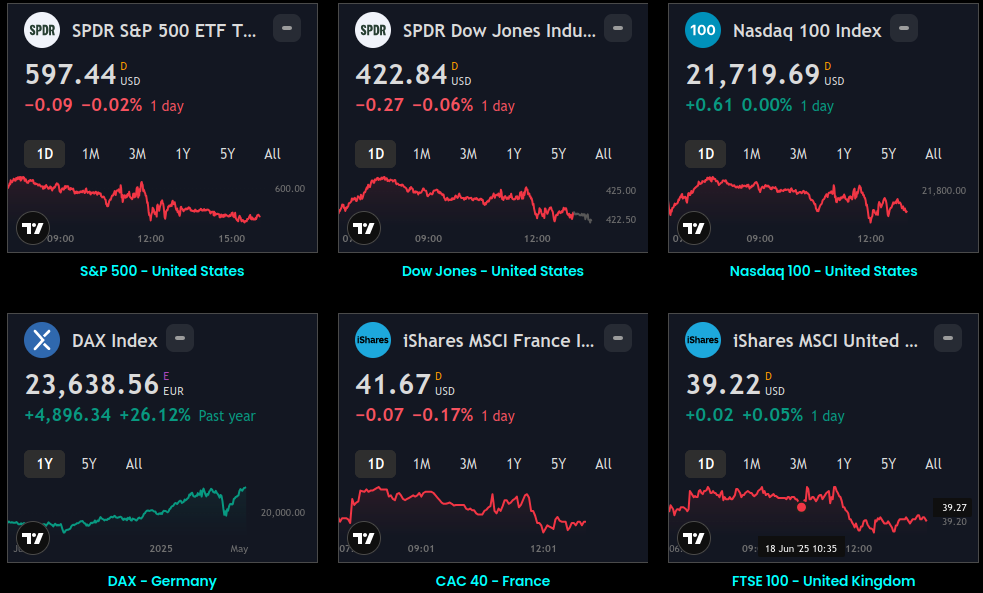
Active Stocks:
 Sage Kakkat
Stocks, ETFs and Funds Screener:
 Sage Kakkat
Forex:
 Sage Kakkat
CryptoCurrency:
 Sage Kakkat
Events and Earnings Calendar:
 Sage Kakkat
This daily briefing is curated from a wide range of reputable sources including news wires, research desks, and financial data providers. The insights presented here are a synthesis of key developments across global markets, intended to inform and spark thought.
No Investment Advice: This content is for informational purposes only and does not constitute investment advice, recommendation, or endorsement.
Timing Note: Each edition is assembled based on the market context available at the time of writing. Timing, emphasis, and interpretations may vary depending on global developments and publishing windows.
