
US Stocks open higher to begin an earnings week that could either stabilize the AI trade or confirm the worst fears of last week's historic chip rout, with Nasdaq 100 futures up 1.2% and S&P 500 futures up 0.5% as Intel surges 4% on a JPMorgan upgrade, CoreWeave bounces 3% from a 25%-down week, China Q3 GDP surprises to the upside at 4.5% year-on-year with retail sales their fastest since March, and Brent retreats 1.8% toward $107 on another Trump Russia-sanctions waiver — all of it a fragile relief bid running directly into Meta and Tesla on Wednesday, Netflix on Tuesday, and Nvidia's GTC Berlin keynote running concurrently through Wednesday.
- S&P 500 futures rose 45.25 points or 0.58% to 7,749, Nasdaq futures surged 357.50 points or 1.22% to 29,748, and Dow futures were barely changed at +23 points — a sharp tech-led bounce-back after the Nasdaq 100's worst week since April 2025. The 10-year Treasury yield fell to 5.085% from Friday's 5.09% close, easing the immediate pressure on growth stock multiples. The rebound is described across multiple desks as a "selective positioning washout recovery" rather than a clean risk-on reset: after eight straight sessions of chip selling, the most aggressive short sellers are covering, and long-only money is returning to beaten-down names, but no new bullish catalyst has emerged — earnings this week are the test.
- Intel (INTC) is the session's standout premarket mover, up 3.8%–4% after JPMorgan upgraded the stock to Neutral from Underweight — reversing a long-standing bearish stance and citing improved foundry prospects and the view that the valuation now adequately reflects the structural headwinds. The upgrade lands as Intel has fallen over 30% from its 2026 high and is one of the most shorted names in the SOX. AMD gained over 2%, Micron Technology rose 2%, CoreWeave climbed 3%, Broadcom added 2.3%, and Nvidia rose 1.1%. Apple and Meta both posted small premarket declines, with Meta earnings due Wednesday after close. The SOX ended last week more than 25% below its June high and 16% below its October 6 peak, matching its longest losing streak since 2008 — the index is in a confirmed bear market regardless of Monday's bounce.
- This week's earnings slate is the most consequential of the entire 2026 cycle for validating or invalidating the AI capital expenditure narrative. Netflix reports Tuesday — the first read on how streaming capex is translating into subscriber monetization. GE Aerospace, General Motors, 3M, United Airlines, and SpaceX also report Tuesday. Wednesday is the week's defining session: Tesla, Meta, IBM, Lam Research, and Texas Instruments all report after close, with Nvidia's GTC Berlin keynote running simultaneously — Jensen Huang speaking before the US Wednesday close means the market will hear TSMC's AI demand validation from the equipment side (Nvidia customer orders) at roughly the same moment Meta and Tesla's AI capex guidance lands. AT&T and Abbott also report Wednesday. Approximately 70 S&P 500 companies report this week in total.
- China's Q3 GDP grew 4.5% year-on-year — beating the 4.4% consensus and accelerating from Q2's 4.3% — with September retail sales rising 1.1% versus the 0.5% estimate, the fastest since March, industrial output up 5.5% at its strongest in six months, and the unemployment rate at 5.2% versus the 5.3% consensus. Year-to-date 2026 growth of 4.6% puts China inside its 4.5%–5% target for the full year. The data landed as China's US Treasury holdings dropped to $590.7 billion — the lowest since August 2008 — a quiet reminder that Beijing continues to reduce dollar exposure even as its economy outperforms. Hong Kong's Hang Seng was closed for the Chung Yeung Festival public holiday.
- A new DeepSeek model release over the weekend briefly revived the January 2025 AI efficiency shock playbook — the concern that competitive Chinese AI development reduces the compute intensity required per AI workload and therefore suppresses chip demand. The reaction was limited and quickly reversed, but the anxiety around Chinese AI efficiency competition has become a persistent background note in the AI trade's risk register, alongside the CoreWeave financing concerns and the Morgan Stanley AMD forecast cut that dominated last week.
- Japan's Nikkei 225 fell 0.62%–0.7% to 64,916–64,855 — its third straight session of losses since the October 6 historic close above 70,000, now down approximately 7.5% from that peak — as SoftBank dropped 2% and the index's heavy weighting in technology and financial names kept it on the back foot even as regional peers recovered. South Korea's KOSPI had a dramatic reversal: opening 3.17% lower and falling as far as 5,488.41 before institutional buyers stepped in — net 574.66 billion won, approximately $432 million, of purchases — to close 1.75%–1.76% higher at 5,767–5,768. Samsung Electronics rose 1.16% and SK Hynix gained 0.39%, both recovering a small fraction of their 20%–25% weekly losses. China's Shanghai Composite rose 0.2%–0.3% to 3,722–3,730 on the GDP beat. Australia's ASX 200 gained 0.3%–0.44% to near 8,833. The broader MSCI Asia-Pacific index climbed 0.6%, its best session since October 9, as the VIX's historical tendency to normalize after Friday spikes provided technical tailwinds alongside the China data and oil pullback.
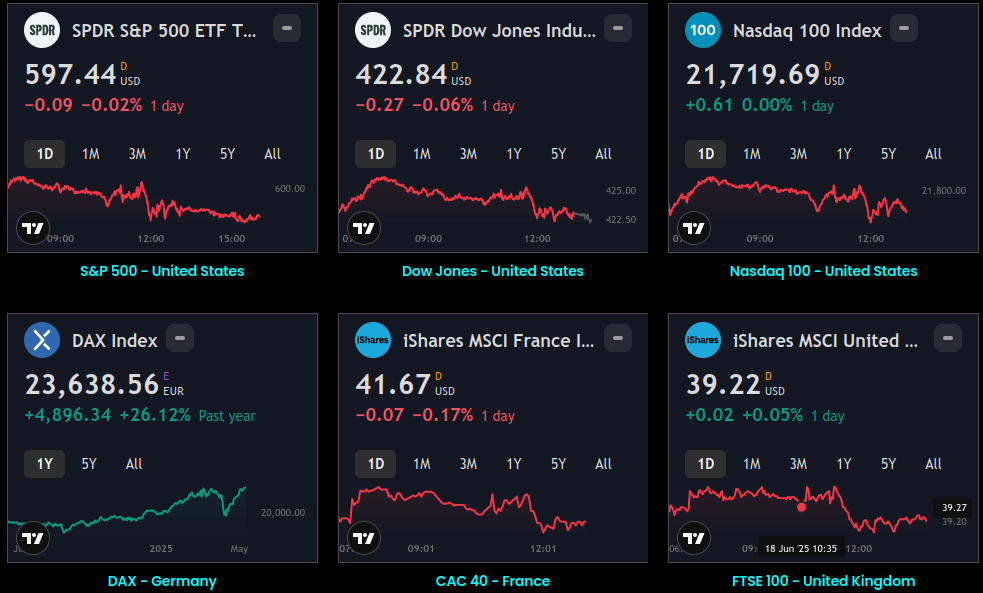
Global Indices:
 Sage Kakkat
Active Stocks:
 Sage Kakkat
Stocks, ETFs and Funds Screener:
 Sage Kakkat
Forex:
 Sage Kakkat

CryptoCurrency:
 Sage Kakkat

Events and Earnings Calendar:
 Sage Kakkat
This daily briefing is curated from a wide range of reputable sources including news wires, research desks, and financial data providers. The insights presented here are a synthesis of key developments across global markets, intended to inform and spark thought.
No Investment Advice: This content is for informational purposes only and does not constitute investment advice, recommendation, or endorsement.
Timing Note: Each edition is assembled based on the market context available at the time of writing. Timing, emphasis, and interpretations may vary depending on global developments and publishing windows.
