
US Stocks started November mixed as an early rally faded: the Dow rose 0.4% on falling oil prices and a rotation out of tech, while the S&P 500 fell 0.5% after erasing a gain that reached 1.1% early in the day and the Nasdaq dropped 1.1%. Brent crude fell about 4% on renewed hopes for US–Iran diplomatic progress, but the AI-spending worries that drove October's sell-off kept pressure on technology. Asia was mixed, with South Korea's KOSPI up 2.4% after an early slide and China's central bank and securities regulator meeting financial institutions on ways to support the markets. Investors now face a heavy week of midterm elections Tuesday, more earnings and Friday's jobs report.
- The S&P 500 fell 38.67 points (0.51%) to 7,541.40, the Nasdaq Composite lost 272.68 (1.07%) to 25,164.32 and the Dow rose 213.67 points (0.41%) to 51,983.98. The Russell 2000 gained 0.21% to 2,805.88. Stocks had opened higher, with the Dow up around 400–500 points at the open, before the rally petered out as investors kept moving money out of tech names and into other parts of the market. For the year, the S&P 500 is up 10.2%, the Dow 8.2%, the Nasdaq 8.3% and the Russell 2000 13.1%. A CNN market gauge read "extreme fear."
- The backdrop is October's heavy tech damage: last month the Nasdaq suffered its worst monthly loss since March 2025 while the Dow rose almost 2% as investors rotated into defensive areas like health care. Friday's sell-off in AI-related shares, driven by Amazon's and Intel's disappointing results, set the tone, and the questions investors are asking about the AI build-out are about financial returns rather than demand.
- Oil dropped sharply, with Brent down about 4% on renewed hopes for progress in US–Iran diplomatic efforts, a tailwind that helped lift the Dow and cyclical sectors even as tech sold off. Economic data was mixed, with US manufacturing activity beating expectations and construction spending unexpectedly falling.
- The week ahead is packed. The US midterm elections are Tuesday, more earnings arrive across the S&P 500, and Friday brings the key jobs report, which feeds directly into the Fed's December decision after last week's PCE showed inflation at 3.6%. With the Fed's two hawkish dissents last week, labor data is likely to move rate-hike odds, and markets are positioned defensively.
- In Asia, South Korea's KOSPI rose 2.38% to 5,859.08 after being down as much as 1.4% early, while the tech-heavy Kosdaq gained 1.38% to 734.36. Over the past month, the KOSPI has fallen more than 16% and Japan's Nikkei more than 7%. The Nikkei 225 slipped 0.33% to 63,081.86 and the broader Topix fell 0.88% to 3,930.28, as major tech names dropped and Brent's fall and softer manufacturing momentum added to a mixed picture. Australia's market also finished lower.
- Greater China rose. The Shanghai Composite gained 1.08% to 3,638.03 and Hong Kong's Hang Seng added 0.42% to 23,393.32, led by tech and consumer cyclical stocks. The People's Bank of China and the securities regulator met financial institutions to discuss ways to support the markets, according to Chinese media reports, with the Shanghai Composite down about 14.6% over the past year and the CSI 300 having entered a bear market last month. The yen was near 157.8 per dollar.
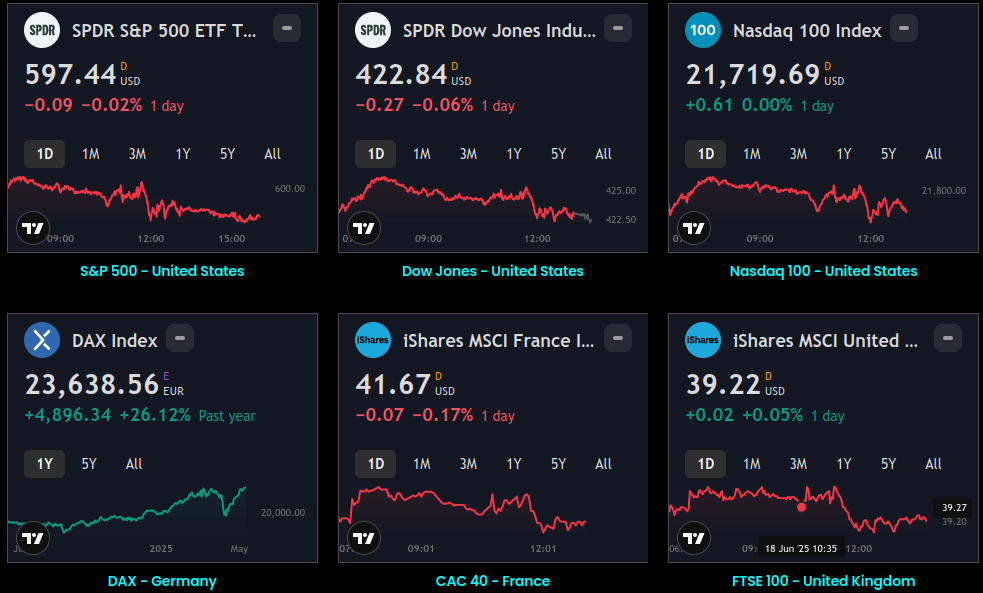
Global Indices:
 Sage Kakkat
Active Stocks:
 Sage Kakkat

Stocks, ETFs and Funds Screener:
 Sage Kakkat

Forex:
 Sage Kakkat

CryptoCurrency:
 Sage Kakkat

Events and Earnings Calendar:
 Sage Kakkat

This daily briefing is curated from a wide range of reputable sources including news wires, research desks, and financial data providers. The insights presented here are a synthesis of key developments across global markets, intended to inform and spark thought.
No Investment Advice: This content is for informational purposes only and does not constitute investment advice, recommendation, or endorsement.
Timing Note: Each edition is assembled based on the market context available at the time of writing. Timing, emphasis, and interpretations may vary depending on global developments and publishing windows.
