
US stocks steadied Friday as AI names bounced and the rest of the market was mixed: the Nasdaq rose 1.1% and the S&P 500 0.3%, while the Dow slipped 0.5%. A strong October jobs report, with payrolls of 165,000 against forecasts of 59,000–65,000, pushed Treasury yields higher and kept a December Fed rate hike firmly in play. Asia fell hard overnight, though, with Japan's Nikkei down about 6% into a bear market and South Korea's KOSPI down 6% after a circuit-breaker halt. For the week the S&P 500 lost 2.7% and the Nasdaq 3.4%, after a post-midterm rally that reversed into Thursday's AI rout.
- The S&P 500 rose 23.13 points (0.3%) to 7,376.86, the Nasdaq Composite gained 264.43 (1.1%) to 24,579.42, the Dow fell 237.33 points (0.5%) to 51,285.73 and the Russell 2000 added 0.9% to 2,754.11. On the week, the S&P 500 fell 2.7%, the Dow 0.9%, the Nasdaq 3.4% and the Russell 2000 2.1%. For the year, the S&P 500 is up 7.8%, the Dow 6.7%, the Nasdaq 5.8% and the Russell 2000 11%. Breadth was weak: roughly 43% of issues fell even as the cap-weighted indexes rose.
- Chips and mega-caps bounced after Thursday's rout, when the Nasdaq-100 lost 6.3% and the S&P 500 about $2.8 trillion in value. Micron rose about 5% after a 17% drop Thursday, and Nvidia, Tesla, Meta and Alphabet all gained. Axon Enterprise was the S&P 500's weakest stock, down about 18%.
- October payrolls beat forecasts by about 100,000: employers added 165,000 jobs, the unemployment rate slipped to 4.1% from 4.2%, and August and September were revised up by a combined 84,000. Average hourly earnings rose 0.4% on the month and 3.1% on the year, though that trails inflation, so real pay fell. Gains were broad, led by professional and business services (about 70,000), health care (42,000), transportation and warehousing (25,000) and manufacturing (19,000). The labor force grew by 421,000 and participation edged up to 61.9%. A principal-asset-management strategist called it a strong rebuttal to slowdown fears.
- Rates: Treasury yields rose after the report and held firmer, with the 2-year up about 6 basis points near 4.52%, the 10-year up about 3 basis points near 4.87% and the 30-year near 5.27% in early trading. December hike odds were around 77–80%, near their recent high, though the AI sell-off and political shifts have lowered odds of further hikes in 2027. Strong jobs and a still-hot inflation backdrop make a December hike harder for the Fed to skip. The next jobs report is December 4.
- Asia's Friday session was the global low point. Japan's Nikkei 225 fell 5.96% to 57,434.77, more than 20% below its June peak, its lowest level since April and officially a bear market. South Korea's KOSPI dropped as much as 8.8%, triggering a 20-minute trading halt, then closed down 6.02% at 5,059.69, down 11.7% on the week. Taiwan's Taiex fell about 4.5% into a bear market, and the MSCI Asia Pacific index tumbled around 4%. China and Hong Kong were less hit: the CSI 300 fell 1.44% to 4,054.28 and the Hang Seng about 1.3% after Thursday's 3.7% gain, while India's Nifty rose about 2%. President Trump wrote on Truth Social that the market "suffered one of the Worst Days in History" because of the election.
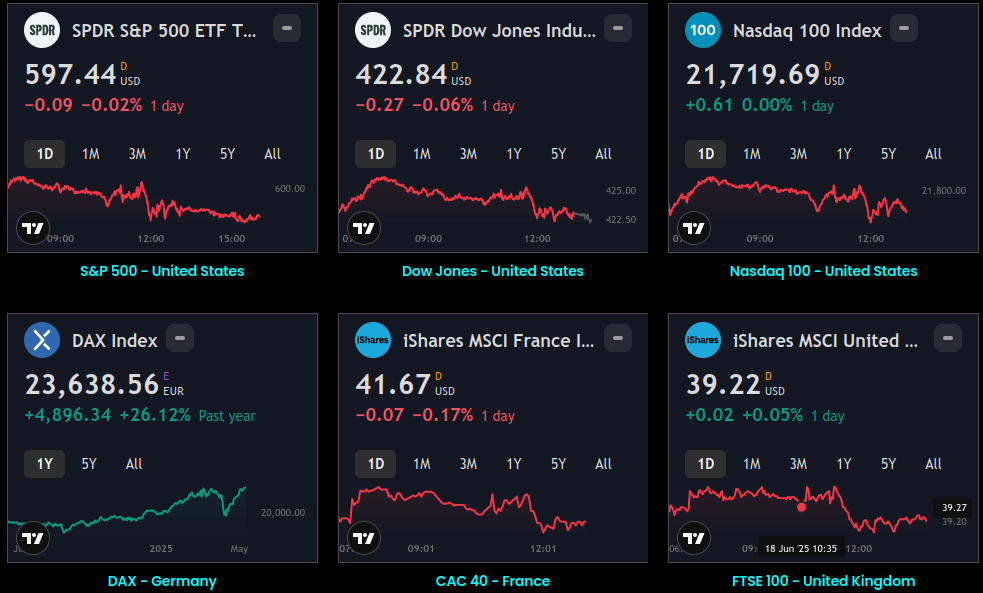
Global Indices:
 Sage Kakkat
Active Stocks:
 Sage Kakkat

Stocks, ETFs and Funds Screener:
 Sage Kakkat
Forex:
 Sage Kakkat

CryptoCurrency:
 Sage Kakkat

Events and Earnings Calendar:
 Sage Kakkat
This daily briefing is curated from a wide range of reputable sources including news wires, research desks, and financial data providers. The insights presented here are a synthesis of key developments across global markets, intended to inform and spark thought.
No Investment Advice: This content is for informational purposes only and does not constitute investment advice, recommendation, or endorsement.
Timing Note: Each edition is assembled based on the market context available at the time of writing. Timing, emphasis, and interpretations may vary depending on global developments and publishing windows.
